



Over my teaching career at the Kellogg School of Management, I have educated thousands of students who went on to build careers at the leading consulting firms. I have trained consultants and partners at many of those firms, and I have advised their leaders. Consulting firms go to great lengths to set themselves apart, but they are all built the same way: as a pyramid, with a few partners at the top, a wide base of analysts and associates at the bottom, and engagement managers in between.
The pyramid is a logical structure, and it follows from the economics of selling expertise. A partner’s time is scarce, and her expertise is valuable. So, the firm spreads that expertise across many engagements by giving the partner a team of less expensive associates. The client pays for the team’s hours at a markup, and the markup on the base of the pyramid pays for the top. David Maister defined this arithmetic decades ago. Profit per partner is the product of margin, billing rate, utilization, and leverage, which is the number of people beneath each partner. Richer partners need a wider base. The up-or-out promotion system keeps the base wide by letting go of most associates before they become expensive partners.
Clients have traditionally paid for the whole consulting firm pyramid because partners cannot deliver expertise without the associates beneath them. But AI can now decouple expertise from execution.
Clients are forced to pay for the whole pyramid because partners cannot deliver expertise without the people beneath them. AI is now disrupting this logic by unbundling expertise from execution. An AI coworker can do much of the research, modeling, and drafting that the firms hired the base of the pyramid to do, and a partner can rent that capacity from a frontier model. That raises a question: how much of a partner’s value belongs to her, and how much to the firm? It depends on the kind of work the client is buying.
Consider Unity Advisory. In 2025, Marissa Thomas, who had run PwC’s UK firm, and Steve Varley, who had chaired EY in the UK, started a CFO advisory firm with up to $300 million from Warburg Pincus. Unity does no audit work. It built AI into delivery from the first day, and it sells to mid-market companies and private equity portfolios. By October 2026, it had about 120 clients, it had won work from the firms its founders came from, and it had fended off a legal threat from PwC. Varley has said that after he left EY, his former clients asked what he would do next and wanted to keep working with him. The clients followed the partners.
Boris Groysberg’s research points the other way. He spent a decade studying star equity analysts who changed firms, and he found that most of them got worse. Their rankings fell when their teams stayed behind. The platform that made them look brilliant was part of the brilliance. Clients follow people, but people perform worse without the platform. The future of the strategy consulting firm depends on which parts of the platform AI has made portable.
What the pyramid gave the partner
Think about how an engagement runs inside the pyramid. A senior partner sells the engagement, an engagement manager runs it, and consultants and analysts do the interviews, build the models, and produce the decks. The partner reviews the work, shapes the storyline with the team, and presents it to the client. That is the leverage Maister described, and a strong book of clients allows a partner to run several teams at once.
The hierarchy gives the partner a second, less visible benefit: it keeps her expertise pointed at the hardest problems. Analysts solve what they can and escalate the rest, and managers do the same. By the time a problem reaches the partner, the people below her have handled the easier parts, so her hours go to the parts that need her expertise. The firm bills the client for the whole chain, and the client pays because the work is sold as a bundle.
The pyramid also made the partner. She was once the analyst who burnt the midnight oil building models and decks, and she learned her craft over years of supervised work lower down in the pyramid. The firm supplies production, routing, and training; the partner supplies judgment and trust; and the client cannot buy one without the other.
How AI shrinks the middle
In an earlier essay, I presented the hourglass model of knowledge work. Let’s apply this model to consulting engagements. Every engagement has a front end, where you frame the question and set the hypotheses. It has a middle, where the team does the research, the analysis, and the drafting. It has a back end, where you test the recommendations, defend them, and turn them into action. I call these stages Design, Do, and Decide. Human judgment matters most in Design and Decide. Most of the hours go into Do, and consulting firms built the pyramid to staff it. AI has moved into Do as a coworker. It reads the filings, drafts the interview guide, builds the first version of the model, stress-tests the scenarios, and produces the storyline that the partner can critique. It does this in hours, and all the partner needs is a laptop and access to Claude or ChatGPT.
Empirical research backs this up, with an important caveat. In one experiment, several hundred BCG consultants worked on realistic consulting tasks. On tasks that AI handles well, the consultants who used it finished about a quarter faster, and evaluators rated their work higher. In a second experiment at P&G, one professional working with AI did as well as a two-person team working without it. But the gains disappear when AI is pushed past what it does well. On a task where AI tended to give a wrong answer, the BCG consultants who used it did worse than those who did not. And in a separate study, experienced software developers took longer with AI on code they already knew well. The lesson: AI can produce a lot of work quickly, but someone with experience must check it.
Exhibit 1 illustrates this idea for a twelve-week strategy engagement. AI cuts the hours in Do by about three quarters. The hours in Design stay about the same, because framing the question still takes a partner’s judgment. The hours in Decide increase, because an experienced person must check all the AI output before it reaches the client. An engagement that once needed about 2,400 person-hours and a team of five now needs about a thousand hours from a partner, a senior adviser, and an engineer, plus a lot of AI.
Exhibit 1. How AI converts consulting engagements from a pyramid to an hourglass
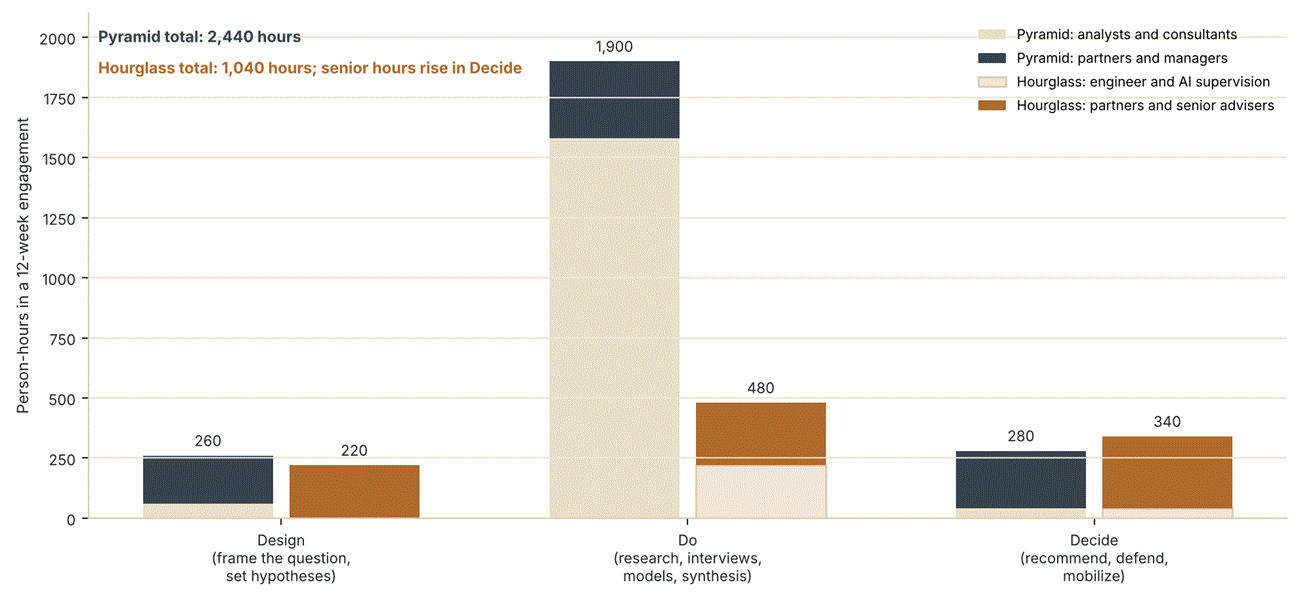
Illustrative staffing for a bounded strategy engagement; the hours are stylized and not a reconstruction of any firm’s actual staffing.
I want to be careful here, because the hourglass is not a free lunch. Using AI in the middle comes with its own costs. You must give it access to your data, test what it produces, and keep it secure. Above all, you need a domain expert to judge when it is wrong. The savings also don’t apply to every engagement. If you’re running a transformation across several countries with lots of stakeholders, you still need people in the room. And it remains to be seen whether a smaller team can deliver the same quality. New ventures like Unity Advisory are promising, but they are young and have yet to prove the model works at scale. So far, we have talked about the hours that AI saves. But the hours don’t tell you who gets paid for them. If a partner can do the work with a small team and a laptop, the client must decide whether they are buying from the partner or from the firm behind her. That’s the question I turn to next.
Whose value is it?
To find out how much of the fee belongs to the partner, let’s list what the client pays for, as Exhibit 2 does. For each item, I ask who owns it, the partner or the firm, and what AI changes.
Exhibit 2. The value ledger: who owns what the client pays for
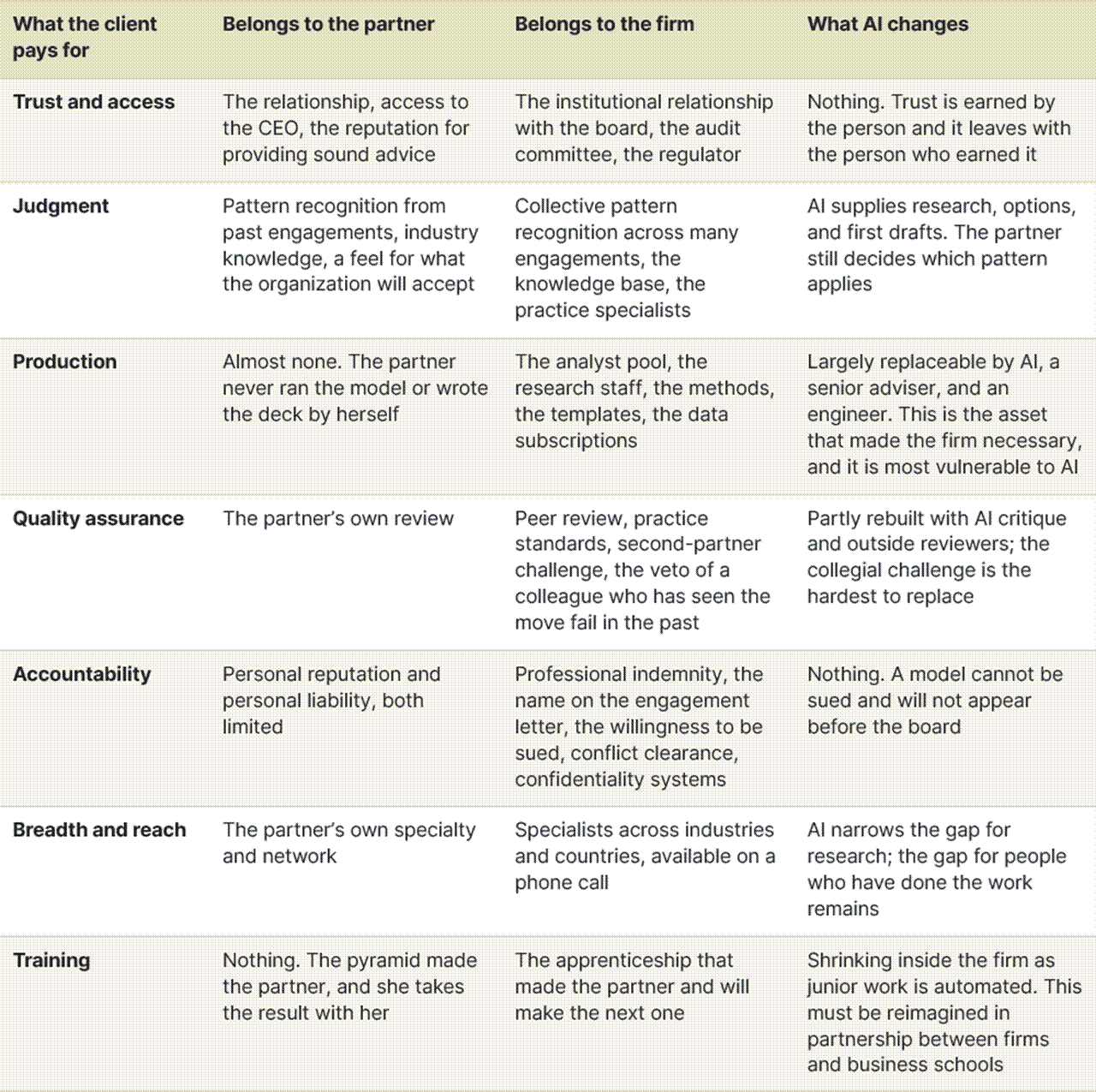
At first glance, the firm’s ledger looks strong. Then read the right-hand column. Production was the asset that made the firm indispensable to the partner, and production is the asset that AI attacks first. The firm keeps accountability, breadth, collegial quality assurance, and training. These matter a great deal for some kinds of work and very little for others. Trust and judgment were always more personal than institutional. The firm could claim them only because the partner could not deliver without the firm’s production. Take that away, and the firm must earn its share of the fee from the assets in its own column.
Accountability is the asset that advocates of AI-native boutiques tend to leave out. A board buys more than advice. It also buys a party to blame, to insure, and to name in the proxy statement when the merger fails. The name on the engagement letter brings professional indemnity, conflict clearance, confidentiality systems that have survived regulators, and the willingness to be sued. A ten-partner boutique can buy insurance and set up a conflicts process, but it can’t buy the comfort a board feels when the McKinsey or Accenture name is on the letter. The bigger the stakes, the more accountability is worth, and AI doesn’t change that.
Partners also tend to underestimate the value of their colleagues. Inside a big firm, a partner can bounce an idea off a colleague before it goes to the CEO. Sometimes that colleague has seen the same move fail at another client and can warn her off it over a cup of coffee. When partners leave to start a boutique, they leave this safety net behind. AI can critique a recommendation, but it can’t tell you, “We tried that at another client, and here’s what went wrong.” Firms could charge for this protection, but so far, they haven’t needed to.
My colleague Subhendu Modak and I built a simulation of a law firm. Law firms are even more pyramid-shaped than consulting firms, so they make a good test case. What we learned surprised us. Clients happily pay double or triple rates for judgment work, and they don’t want AI anywhere near it. That willingness to pay rests on the firm’s reputation, which takes years to build. Senior lawyers earn it by doing the hard work themselves. But it can erode quickly if the firm automates too much, makes a costly mistake, or lets its best senior people go. And here’s the key point: the reputation belongs to the firm, not to any one lawyer. A rainmaker can walk out the door and take his clients with him, but he can’t take the reputation that made those clients willing to pay a premium. That’s exactly what Groysberg found with star analysts.
Where a partner can win without the firm
The ledger shows that the answer depends on the kind of work the client wants done. Exhibit 3 maps that work along two questions. First, how much does the client need a big firm’s name to stand behind the advice? Second, how much analysis and grunt work does the job require, now that AI can do much of it? In the lower half of the map, where the client doesn’t need the firm’s name, a partner can compete on her own.
Exhibit 3. The mandate map, and how much of the value follows the partner
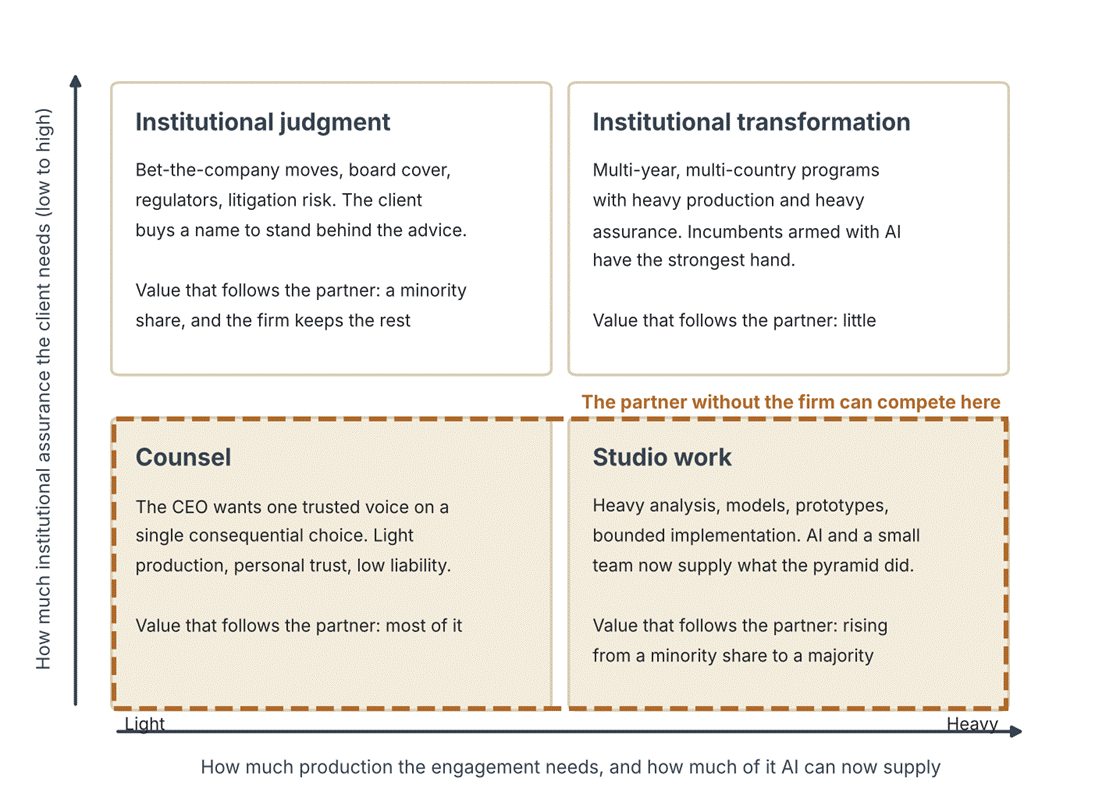
Let’s walk through Exhibit 3 one quadrant at a time. I call the lower left quadrant “Counsel.” Here the CEO wants one trusted voice on a big decision. There isn’t much analysis to do. The stakes are high, but the CEO makes the call and owns it, so she doesn’t need a big firm’s name behind the advice. Picture a CEO deciding whether to sell a division or replace a top executive and calling the one adviser she trusts. Elite partners have done this work on their own for decades, as senior advisers and board members. Most of the value here belonged to the partner before AI, and it still does.
The lower right quadrant is new ground, and I call it “Studio work.” The client still doesn’t need a big firm’s name behind the advice, but the job takes a lot of analysis: models, scenarios, prototypes, and some hands-on help putting the plan in place. Think of a market entry, a pricing redesign, a portfolio review, or the strategy for a business unit. In the past, only the pyramid could take on this work, because it took a wide base of analysts, and most of the value went to the firm. Today, AI and a small team can do it, and a partner the client trusts can sell it. This is the quadrant that AI changes the most. Most of the value now follows the partner, and studio work makes up a large share of what the strategy firms bill today.
Next is the upper left, which I call “Institutional judgment.” These are the bet-the-company moves: a hostile bid, a restructuring that will end up in court, or a settlement with a regulator. The analysis may be modest, but the stakes are high, and the board wants a name it can stand behind. That name belongs to the firm, not to the partner.
Last is the upper right, which I call “Institutional transformation.” These are the multi-year programs that cut across countries and functions, and they need both a lot of work and a trusted name. The firm still needs many people on the ground, and big firms armed with AI are strong here. If you plan to leave your firm, don’t expect to win the work in either of the top two corners.
Step back from the map, and you can see how exposed the big firms are. They earn money in all four quadrants, but the bottom two are now up for grabs. And the people coming after that work aren’t strangers. They’re the firm’s own former partners, who know the clients and know how the firm works. The firm has two ways to defend itself. It can shift its work up the map, toward the jobs where clients need its name. And it can charge openly for what only the firm provides: accountability, breadth, peer review, and training. If it does both, it can keep its premium. If it keeps billing for the analysis that AI now does, that premium will walk out the door with the partners who leave.
Experts who follow the consulting industry have proposed many new shapes of the post-AI consulting firm. Some say it will look like an obelisk, others a diamond, an upside-down pyramid, or a box. Each drawing is a guess at how many people a firm will need at each level once AI takes over the junior work. They aren’t really competing predictions. Each one describes a firm that has picked one quadrant and staffed for it. Counsel needs almost no base. Studio work needs a thin layer of engineers and senior advisers beneath each partner, and that is the diamond. Institutional transformation still needs many people in client rooms, and that is a pyramid with AI inside it. A firm that works in all four quadrants needs all these shapes, one for each kind of work. In the end, the work the client buys decides how a firm should be staffed and how it makes money.
Sleeping with the enemy: Consulting firms and frontier labs
Until recently, a partner who left with her clients had a problem. Who would do the research, the modeling, and the drafting? In 2026 the frontier labs answered that question. OpenAI signed Frontier Alliances with McKinsey, BCG, Accenture, and Capgemini in February. In May it launched its own Deployment Company, which OpenAI majority-owns and in which McKinsey, Bain, and Capgemini invested. Anthropic launched Ode in July with Blackstone and Hellman & Friedman. Ode places engineers inside enterprises to build and run AI systems. In August, Anthropic signed Bain as a Global Premier partner and deployed Claude to 19,000 Bain employees. In October it opened its Frontier Academy, a $100 million program to train 10,000 forward-deployed engineers by the end of 2027, with cohorts from Accenture, Bain, Deloitte, and McKinsey, including engineers from McKinsey’s QuantumBlack. In November it joined Hg in a European deployment venture. Warburg Pincus financed Unity Advisory separately. Within a year, the labs, the consulting firms, and the private equity funds built a web in which each party needs the others and also competes with them.
Each party brings something the others lack. The labs supply the models and want a way into large companies. The consulting firms have the client relationships and the deployment playbooks, and they need the models to compete. The private equity funds have capital and a built-in market in the companies they own, and they want to own a services platform instead of paying fees to one. And they all need more of a new kind of person: the forward-deployed engineer who turns a model into a working system inside a client. The labs train these engineers. The consulting firms send their own people to learn from the labs that fund their rivals. The funds buy companies full of them, and client companies try to hire them away from everyone else. Think of the Frontier Academy as an old-fashioned apprenticeship with a budget. The lab is happy to pay for it, because the lab profits from the work those engineers go on to do. Consulting firms used to have the same deal with their junior staff, and they are losing it.
Let’s follow the money. The lab wins no matter who gets the client. It earns on model usage if the consulting firm wins, on equity and usage if a deployment venture wins, and on usage again if the client builds in-house. The consulting firm earns only when it wins, and it can’t walk away from the labs, because it needs their models and their training. The firms have hedged. McKinsey, Bain, and Capgemini invested in a venture that competes with their own implementation arms. The private equity funds hedged too: they backed Ode and the Hg venture to get deployment capacity without paying consulting rates, and they backed Unity, the partner who left.
For that partner, this removes the last reason to need the firm. She can rent the work from the labs, hire engineers the labs trained, and raise money from the funds. The firm has a more difficult task. It must partner with the companies building its replacement in the lower half of the map, while its own people become the labs’ deployment workforce. It keeps the upper half of the map, but it is no longer the one doing the work.
The pushback from senior partners
I can already hear the pushback from the managing partners of the big firms. It goes something like this: “CEOs don’t hire us for analysis. They hire us for judgment, independence, credibility with the board, and the muscle to move a large organization. We can use the same AI as any boutique, and we bring more specialists, more reach, a reputation built over generations, and the training that makes future partners. Why would a CEO bet the company on a handful of people and rented technology?”
They have a point, and for the work in the upper half of the map, they’re right. The firm does own the name, the accountability, and the peer review. It can use AI at least as well as a boutique can, and a boutique has no way to train its own partners. But the argument breaks down in the lower half of the map. It assumes clients will keep giving that work to the big firm out of habit, and they won’t. The partner who left knows the client, the client trusts her, she can rent the analysis, and she charges less.
The boutique model looks promising, but it hasn’t been proven. On paper, a small firm of senior partners working with AI can charge less than a big firm and still pay its partners more. That only works if three things hold. The partners must win work without a famous name behind them. The technical work must stay manageable. And clients must not discount advice because it comes from a smaller firm. If even one of them fails, the advantage starts to disappear. Where would I place my bet? On the boutique for work in the lower half of the map, and on the big firm for work in the upper half.
What I predict, and what firms must do
Here is what I predict will happen. First, the big firms won’t collapse. Instead, we’ll see a long, slow fight, and some partners will leave and do well in counsel and studio work. Second, the big firms will fight back by moving up the map, charging openly for what only they provide, and building studios of their own. Third, the labs will profit no matter who wins. Fourth, clients will get the same judgment for less, and they’ll pay the big-firm premium only when they truly need the big firm. The pyramid will shrink at the bottom of the map and hold at the top. Finally, the firms that thrive will run two organizations side by side: a studio that does expert work with small senior teams and plenty of AI, and a guild that trains the next generation of partners on its own budget, because clients will no longer pay for that training. The firms will survive. The bundle will not.
Large consulting firms must run two organizations side by side: a studio where small senior teams do expert work with AI, and a guild that trains future partners at the firm’s expense.
What should you do as AI pulls the partner and the firm apart? If you are a senior partner, start with an honest audit. Go through what your clients pay for, line by line, and separate what they buy from you from what they buy from the firm. Be especially honest about two things that are easy to take for granted: the firm’s name on the letter, and the colleagues who catch your mistakes. If most of your work sits in the lower half of the map, and most of what your clients value comes from you, you are worth more on your own than your pay suggests. If most of your work sits in the upper half, you’re better off staying, because the firm is worth more to you than it costs you.
If you run a big firm, lead with the work that only a big firm can do: the bet-the-company decisions where the board wants a name it can trust, and the large transformations that need many people across many countries. Show clients exactly what the premium buys, so they can see the difference when a boutique bids against you. And build a studio of your own before one of your former partners beats you to it. Keep it small: a few senior people, a couple of engineers, and plenty of AI. Then build a guild next to the studio, with its own budget and its own goals. The way you turn young analysts into partners is the one thing a boutique can’t copy. But as AI takes over the junior work, that training won’t happen on its own anymore. You’ll have to fund it intentionally.
If you’re a CEO buying this work, ask yourself what you’re really buying before you sign. For counsel or studio work, you’re paying for the partner, and a boutique may give you the same person for a lower fee. When your board needs a name it can stand behind, pay for the name, and make sure you also get the colleagues who will push back on the advice. Just don’t pay big-firm prices for studio work out of habit, and don’t hand a boutique a decision that may end up in court.
Picture the partner on the morning she leaves. She takes no files and no team with her, only her clients’ trust and a laptop. For most of the history of consulting, that was never enough. Today, for a growing share of the work, it is. The pyramid made her, and now it will have to earn her back.
Sources
Anthropic. “Bain & Company Joins the Claude Partner Network as a Global Premier Partner.” August 25, 2026.
Bain & Company. “Bain & Company Invests in the OpenAI Deployment Company.” Press release, May 11, 2026.
Becker, Joel, Nate Rush, Elizabeth Barnes, and David Rein. “Measuring the Impact of Early-2025 AI on Experienced Open-Source Developer Productivity.” METR, July 10, 2025.
Business Wire. “Anthropic, Blackstone, and Hellman & Friedman Introduce Ode with Anthropic.” July 15, 2026.
CNBC. “Anthropic to Invest $100 Million to Train AI Engineer Talent.” October 2, 2026.
———. “OpenAI Lands Multiyear Deals with Consulting Giants in Enterprise Push.” February 23, 2026.
Dell’Acqua, Fabrizio, Charles Ayoubi, Hila Lifshitz, Raffaella Sadun, Ethan Mollick, Lilach Mollick, et al. “The Cybernetic Teammate: A Field Experiment on Generative AI Reshaping Teamwork and Expertise.” NBER Working Paper 33641, April 2025.
Dell’Acqua, Fabrizio, Edward McFowland III, Ethan Mollick, Hila Lifshitz-Assaf, Katherine C. Kellogg, et al. “Navigating the Jagged Technological Frontier: Field Experimental Evidence of the Effects of AI on Knowledge Worker Productivity and Quality.” Harvard Business School Working Paper 24-013, September 2023.
Duncan, David, Tyler Anderson, and Jeffrey Saviano. “AI Is Changing the Structure of Consulting Firms.” Harvard Business Review, September 2025.
FStech. “PwC and Unity Advisory Locked in Legal Dispute.” February 2026.
Groysberg, Boris. Chasing Stars: The Myth of Talent and the Portability of Performance. Princeton, NJ: Princeton University Press, 2010.
Harris-Davison, Rosie. “Private Equity-Backed Unity Advisory Hits 120 Clients as Former Big Four Chiefs Target Rivals.” City AM, October 2026.
HgCapital Trust. “Hg Invests in New AI Venture alongside Anthropic.” RNS announcement, November 3, 2026.
Maister, David H. Managing the Professional Service Firm. New York: Free Press, 1993.
———. “Results and Rewards in the Multi-Group Firm.” davidmaister.com.
Sawhney, Mohanbir, and Subhendu Modak. Agency: Org Design and AI Strategy Simulation. Pedagogix, 2026.
SiliconANGLE. “OpenAI Launches Professional Services Business with $4B Investment.” May 11, 2026.
Warburg Pincus. “Warburg Pincus Announces Partnership with Marissa Thomas and Steve Varley to Launch Unity Advisory.” Press release, June 30, 2025.