



Your company has an HR department. It recruits talent, onboards new hires, manages performance, handles compensation, ensures compliance, and plans for the future of the workforce. No serious company would operate without it.
Now ask yourself: who is doing any of this for your AI agents?
Large enterprises are deploying agentic AI across every function, from marketing to finance to customer service. These agents read documents, draft responses, make recommendations, flag risks, and interact with customers. Some operate around the clock. Some make decisions that affect revenue. Some touch sensitive data.
But these digital workers have no onboarding process, no performance reviews, no governance structure, no clear ownership, and no one tracking whether they’re actually delivering value. They are, in effect, feral employees: hired enthusiastically, deployed tactically, and managed by no one.
Your human workforce has an entire management discipline behind it. Your digital workforce needs one too. I call it Digital Labor Orchestration (DLO), and this article is its blueprint.
The Parallel That Changes Everything
The simplest way to understand DLO is through a mirror. Hold up your existing HR function and ask: what would this look like for AI agents?
Hiring employees becomes sourcing and selecting digital agents. Do you build your own? Buy from Salesforce or Microsoft? Outsource to a service provider? The decision depends on the same factors as human talent acquisition: strategic importance, IP sensitivity, and cost.
Onboarding and training becomes configuring and fine-tuning agents. Just as a new hire needs context, tools, and expectations, an AI agent needs prompt engineering, access permissions, guardrails, and escalation rules. Skip this step and you get the AI equivalent of an employee who was never told what their job actually is.
Performance management becomes monitoring agent effectiveness. What are the accuracy rates? Completion rates? How often does the agent escalate versus resolve? Are its outputs drifting over time? You wouldn’t tolerate a human employee who was making expensive mistakes and messing up their jobs. Why tolerate agents that hallucinate or go off the reservation?
Compensation and costing becomes understanding the true economics of digital labor. The sticker price of an API call is not the cost of digital labor, just as a salary is not the total cost of employing a human. You need to account for compute, licensing, monitoring, retraining, exception handling, and human oversight. I call this the Total Cost of Labor Ownership (TCLO): the sum of human labor cost, digital labor cost, and orchestration cost.
Compliance and ethics becomes guardrails, auditability, and explainability. When an AI agent makes a loan decision, who’s liable? When it generates customer-facing content, who reviews it? When it fails silently, who notices?
This isn’t a metaphor. It’s an operating model.
From Jobs to Flows
Here’s where DLO parts company with traditional workforce thinking. In the human world, work is organized in terms of roles and titles: “marketing manager,” “loan officer,” “customer service representative.” In the DLO world, the organizing principle is workflows, broken down into tasks and micro-tasks.
The first step in any DLO initiative is what I call a Workforce X-Ray: a deep diagnostic that decomposes roles into the actual tasks people perform, then evaluates each task for its potential to be handled by a digital agent. A European bank that performed this exercise on its loan origination function discovered over 120 micro-tasks, from intake and document review to fraud checks and credit decisioning. Some tasks were obvious candidates for automation. Others required human judgment. Most fell somewhere in between.
This decomposition is where the real insight lives. A “loan officer” is not one job. It’s dozens of micro-tasks stitched together by habit and job description. Some of those tasks are ripe for AI. Others are deeply human. The art is in the balancing.
The Four A’s: A Volume Dial for Autonomy
Once you’ve identified which tasks can be handled by digital agents, the next question is: how much autonomy should an agent have? This is not a binary choice between “automated” and “not automated.” It’s a dial with four settings.
Assist. The agent enhances human productivity through insights, summarization, or suggestions. A marketing copilot recommends headlines. A research agent summarizes competitive intelligence. The human decides. The agent informs.
Approve. The agent performs the work, but a human must approve before anything executes. A contract analysis tool identifies risk clauses, but legal counsel signs off. The agent proposes. The human ratifies.
Audit. The agent operates autonomously, but its decisions are reviewed after the fact. A dynamic pricing agent adjusts rates in real time. A human audits a sample weekly. The agent acts. The human verifies.
Autopilot. The agent owns the workflow end to end without human intervention. An inventory replenishment system orders stock based on real-time demand signals. The agent decides. The human has moved on to higher-order work.
The instinct of most executives is to jump straight to Autopilot. Resist it. The right autonomy level depends on the risk profile of the workflow, the maturity of the agent, and the trust your organization has built through experience. A billing dispute agent at a logistics company might start at Audit (handling tier-1 cases independently, with 10% weekly human review) and graduate to Autopilot in low-risk regions only after three months of demonstrated performance. High-risk markets might stay at Audit permanently.
The Four A’s give you a common language for a conversation that every enterprise is having in fragmented, inconsistent ways.
The Agentization Map: Where to Start
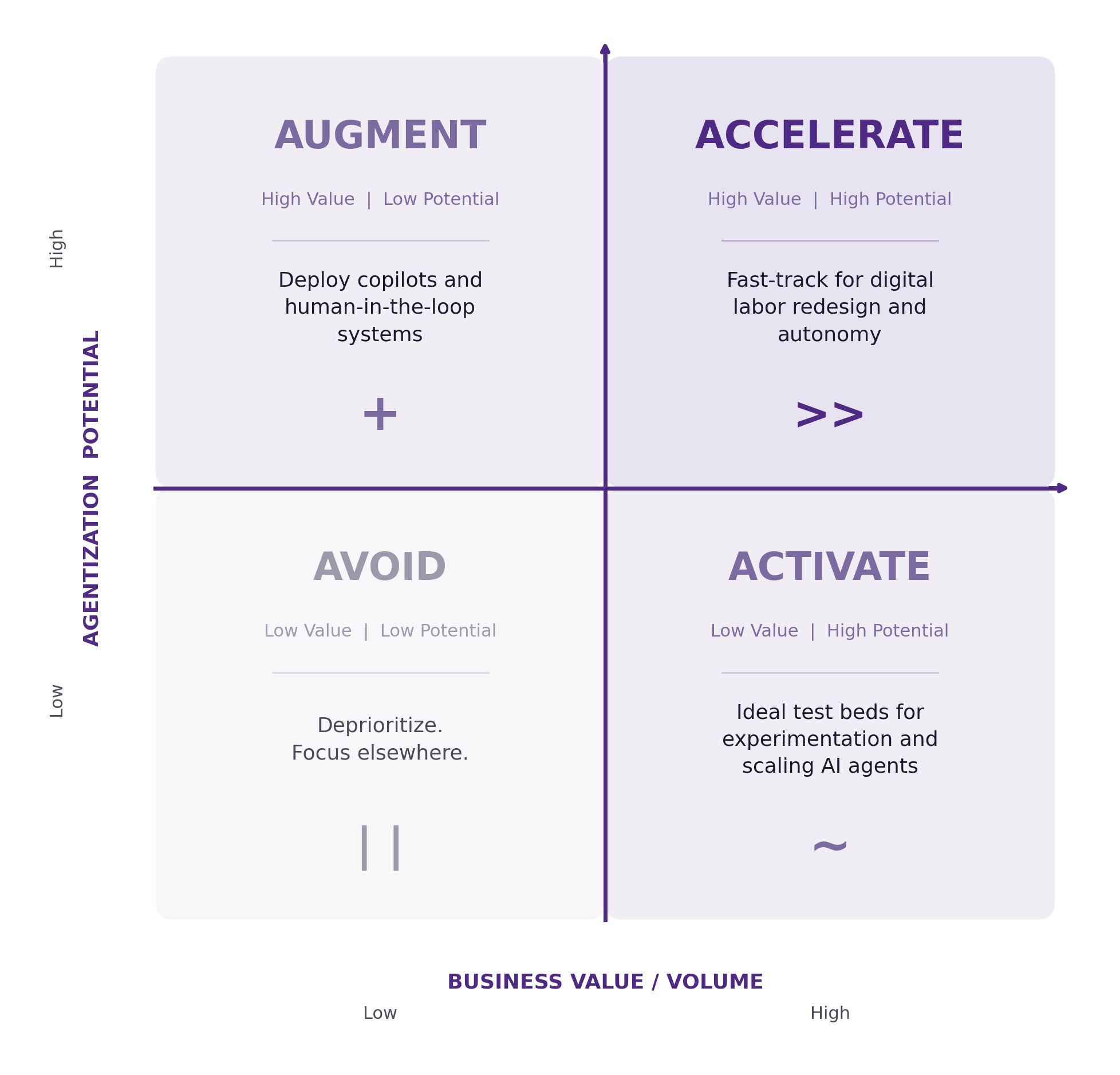
Not every workflow deserves digital labor, and not every promising workflow deserves the same level of investment. To prioritize, plot your workflows on a 2×2 matrix (See the diagram below):
• Y-axis: Agentization Potential (how well-suited is this workflow for AI agents?)
• X-axis: Strategic Importance or Volume
This produces four zones:
Accelerate (high value, high potential): Fast-track these for digital labor redesign. This is where your biggest ROI lives.
Activate (low value, high potential): Perfect test beds. Low risk, high learning. Use these to build organizational capability before tackling the high-stakes workflows.
Augment (high value, low potential): Deploy copilots and human-in-the-loop systems. The work is too complex or too risky for full automation, but AI can make humans significantly more effective.
Avoid (low value, low potential): Don’t waste resources here. Focus elsewhere.
This map turns a sprawling, overwhelming question (“where do we start with AI agents?”) into a portfolio decision with clear priorities
Building the Digital Labor Office
If DLO is the discipline, the Digital Labor Office is the institutional home. Think of it as the organizational equivalent of HR, but for your AI workforce. It’s headed by a senior executive (call it Head of Digital Labor) and staffed with:
Workflow Architects who map processes and redesign them for human-AI collaboration
Agent Designers who configure, prompt, and embed guardrails into digital workers
Governance and Risk Officers who ensure compliance, auditability, and appropriate autonomy levels
Human-AI Partnership Managers who handle change management and ensure human workers embrace (rather than fear) their digital colleagues
Agent Product Managers who treat each digital agent as a product with a backlog, performance metrics, and lifecycle
This team works in deep partnership with HR. Together, they co-own workforce planning (how many humans, how many agents?), role redefinition (what does a “loan officer” do when AI handles 60% of the micro-tasks?), and cultural transformation (how do you move from “AI is taking my job” to “AI is making my job more interesting”?).
I recommend a hub-and-spoke operating model: a central DLO team sets strategy, tools, and policies, while embedded DLO Champions in each business unit adapt and execute locally. This mirrors the HR Business Partner model that is common in human workforce management.
Measuring What Matters
A common mistake in digital labor is measuring only cost savings. Yes, a bank that deploys AI agents in loan origination can cut processing costs by 60% and improve speed-to-decision by 40%. Those numbers matter. But they’re the floor, not the ceiling.
DLO measurement should span three dimensions:
Productivity. Not just human productivity, but blended productivity. I propose a metric called Blended Workforce Productivity (BWP): total output divided by the sum of human labor input (in FTEs) plus digital labor input (in ATEs, or Agent-Time Equivalents). This puts humans and agents on the same scorecard.
Cost efficiency. The TCLO model described earlier, tracking not just compute and licensing but orchestration costs: governance, exception handling, supervision, and change management.
Strategic impact. Speed to market, customer experience uplift, innovation enablement, operational resilience. If a bank can cut loan approval time from 4 days to 40 minutes, it won’t just save money. It will increase application volumes because of the improved customer experience.
The Journey Ahead
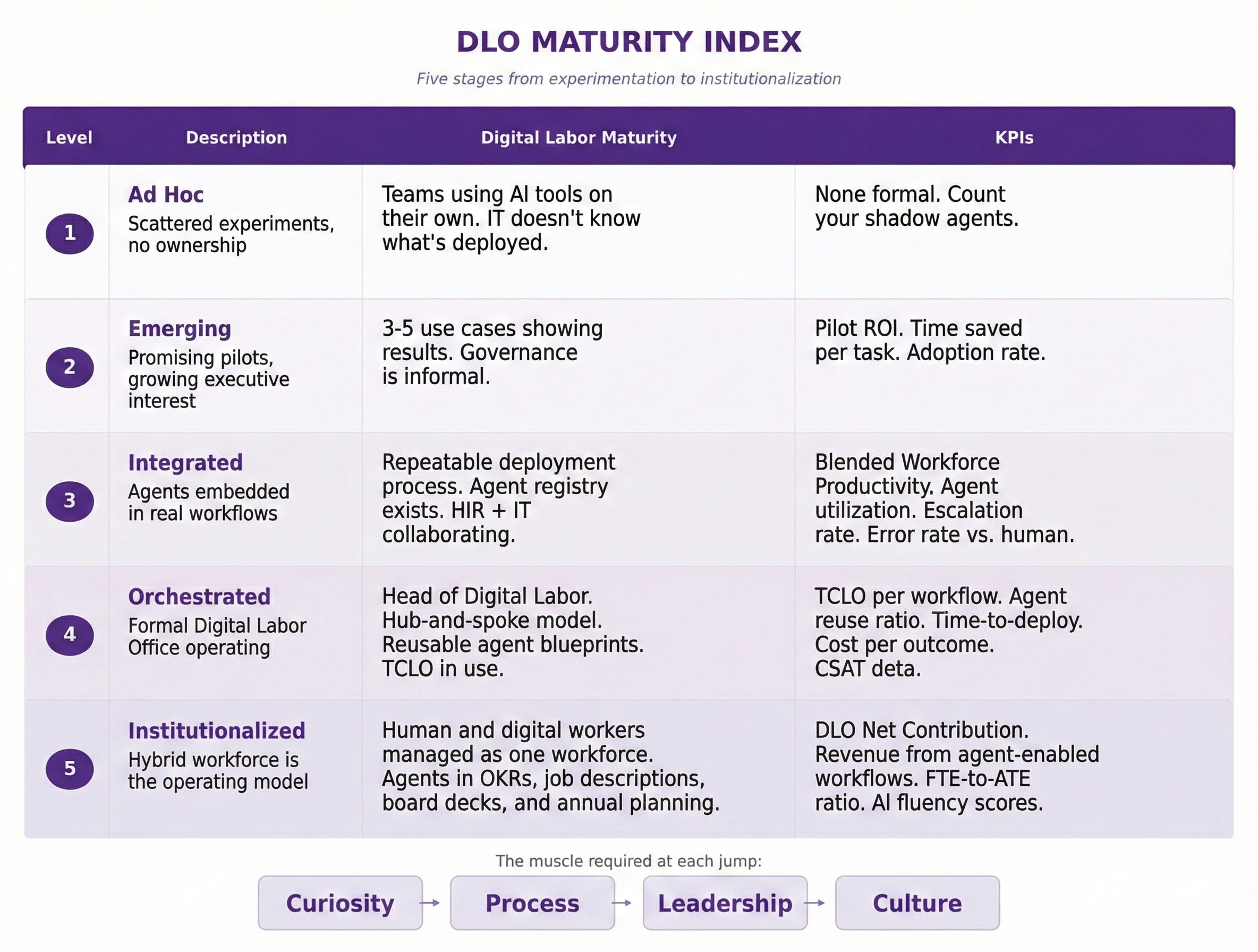
Most enterprises today deploy AI agents sporadically, with no unified strategy for sourcing, governing, or measuring their digital workforce. Digital Labor Orchestration is a journey. To map this journey, I have created a DLO Capability Maturity Model with five stages of maturity, from Ad Hoc deployments with no formal structure to Institutionalized operations where digital labor is embedded in the company's operating model, talent strategy, and performance management systems. See the Table below for the full maturity model with dimensions, capabilities, and diagnostic indicators at each stage.
Digital Labor Orchestration is not a technology initiative. It is a management discipline. The companies that built great HR functions gained a durable advantage in the human capital era. The companies that build great DLO capabilities will gain the equivalent advantage in the age of AI.
Your AI agents are already working. Now you need to figure out how to manage them as employees.