


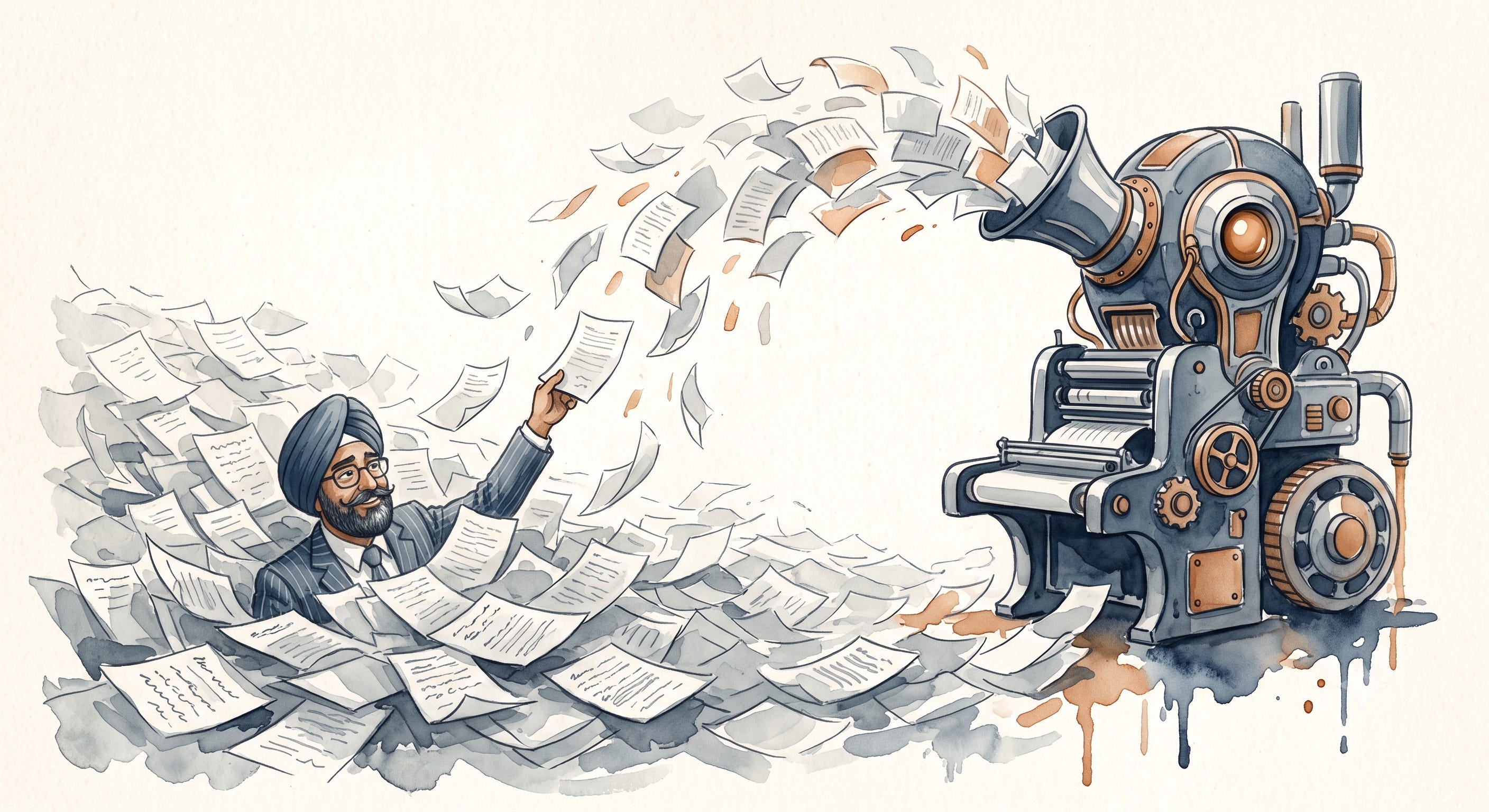
A few weeks ago, my wife asked me a question that stumped me. “You told me these AI tools are making you far more productive. So you should now have a lot of free time,” she said. “So where did the hours go? You are busier than you have ever been.”
I started to say something clever and stopped, because she was right on both counts. The tools have made me dramatically faster. A case study that used to take me six weeks to draft now takes two days. A keynote that once consumed a week of painstaking research and polishing comes together in a few hours. I say this proudly to my colleagues, my friends, and yes - to my wife. Yet, I have never worked harder and with more intensity. My project list is longer, and I am working more hours doing the very creative work the machines were supposed to take off my plate.
At first, I thought this was a personal failing. I thought I needed more discipline and clearer boundaries. But then I realized that my predicament was neatly explained by a Victorian economist in 1865, in a book about coal.
The man who saw it coming
His name was William Stanley Jevons, and he was worried that England would run out of coal. The prevailing view was that engineering would take care of it. Steam engines were improving constantly. Each new design squeezed more work out of every ton. Surely, as the engines got better, England would burn less coal.
Jevons argued the opposite. When steam power became cheap, people found new uses for it. Coal-fired steam engines could now be used in factories, on railways, on ships. Every individual engine burned less coal for the work it did, yet England as a whole burned more coal than at any time in its history. Making the fuel go further grew the appetite for coal, because so many things that had been too expensive to do were suddenly worth doing.
My wife’s question made me realize that I am living through a personal version of the Jevons paradox. My fuel is my time. The tools have made every hour go further than it ever has. And I am doing what England did. I have found new uses for the hours. I am doing even more with more hours than before!
The bottomless well
Like most authors and scholars, I have more ideas than time. Articles I have thought about but have not written. Frameworks I have sketched on napkins and thrown away. Books that exist in fuzzy contours in my head, never to see a keyboard and a screen. I have treated this pile of undone, unthought, and unwritten work as a backlog, something I might clear if I ever took a sabbatical or miraculously found days of uninterrupted time. I now see it differently. It is a well without a bottom. Every teacher and writer I know carries one. You never run out of things you wish you had created. You only run out of time to create them.
The tools did not empty the well. What they gave me is a longer rope and a bigger bucket. So I am drawing deeper from the well. The simulation that lived in my imagination for a decade got built this spring, and then it became a pipeline of four. The occasional essay became a weekly publication. The book of essays on life I had been planning for years is written, to be published in a few months. These things did not happen because I suddenly found spare hours lying around. They happened because work that used to cost weeks now costs a few hours. At this lower price, I find myself saying yes to things I had been saying no to for twenty years.
There is a another thing going on, which is quietly consuming more fuel. I have raised my standards. For years, one well-crafted deck served most groups of executives I taught, because building fresh materials for each program was too time-consuming. Now every program gets its own lectures, its own exercises, its own examples grounded in the precise context of the people in the room. Once you have taught that way, going back feels like serving leftovers. And once the people you serve have tasted it, they begin to expect it. What felt like going well beyond the call of duty last year is simply the standard this year. My own standards rose right alongside theirs, and higher standards consume more hours than AI tools generate.
Where the hours went
So where did the hours go? They went into work I could not have done before. They went down the well.
To be clear, I am not complaining. My attitude is mostly gratitude. I am not busier because a machine trapped me. I am busier because a lifetime of postponed ideas suddenly became possible, and I embraced them. The tools did not hand me back my evenings. They raised what I ask of myself. If you had told me at forty that one day I could build in a season what once took years, and then asked whether I would use that power to rest, I would have laughed. Of course I would use it to build. That is who I am.
But the calculus of hours does have a dark side. The well has no bottom. I do. My attention is finite. My energy is finite. My working seasons, however many remain, are finite. A bottomless well paired with a bigger bucket is a wonderful gift and a genuine danger, because the well will accept every hour I choose to give it, and it will never once say thank you, that is enough. If I am not careful, I will burn myself out, and hurt the people who deserve my time and attention. Like my wife and children.
Adding a governor
James Watt had an insight that I could really benefit from. He did not trust the steam engine to limit itself. So, he bolted on a device called a governor, a pair of spinning weights that throttled the steam when the engine exceeded its safe speed. The limit was not in the engine. Left to its own devices, the engine would run faster as you added more fuel to it. The restraint had to be added, deliberately, from outside.
No AI tool will ever come with a governor installed. The tools answer the question of how, brilliantly and tirelessly. So, I must build my own governor. A fixed number of big projects each season, chosen because they matter and no longer because they are affordable. Evenings that stay empty on purpose. A standing permission to leave good ideas in the well, not as a failure of energy, but as an act of judgment about what my remaining seasons are for.
Jevons feared England would exhaust its coal, and eventually it largely did. The reserve I am drawing down is smaller and closer to home: attention, health, time at the dinner table. The engine will gladly burn every hour I feed it, and it will do more with each one than the last. How much to feed it was never the engine’s decision. It is mine. And as my wife reminded without quite saying so, it is a decision I must make mindfully.
I have been on the same treadmill, as rightly pointed out a long list of postponed projects are back, but still a lot of work I was busy with us automated. Iam spending a lot more time now reading and writing on substack and finding newer problems and newer avenues. I think it's a habit, the brain has got used to stimulation and problem solving. I had run of battery today and there was no power so today I went on a date with my son for the first time in a decade we had dinner and then a horror movie. I am now trying to get back to swimming, cycling and renewing my gym membership all of these after half a decade thanks to ai tools.
You should compile these articles into a book of wisdom. Grateful.