


A lot has been written about which jobs AI will replace and which tasks it can automate. I believe this is the wrong question. I have spent thousands of hours building articles, models, courses, and simulations with AI, and I see a clear pattern emerging. AI is not taking over the job so much as changing its shape.
AI is not taking over the job so much as changing its shape.
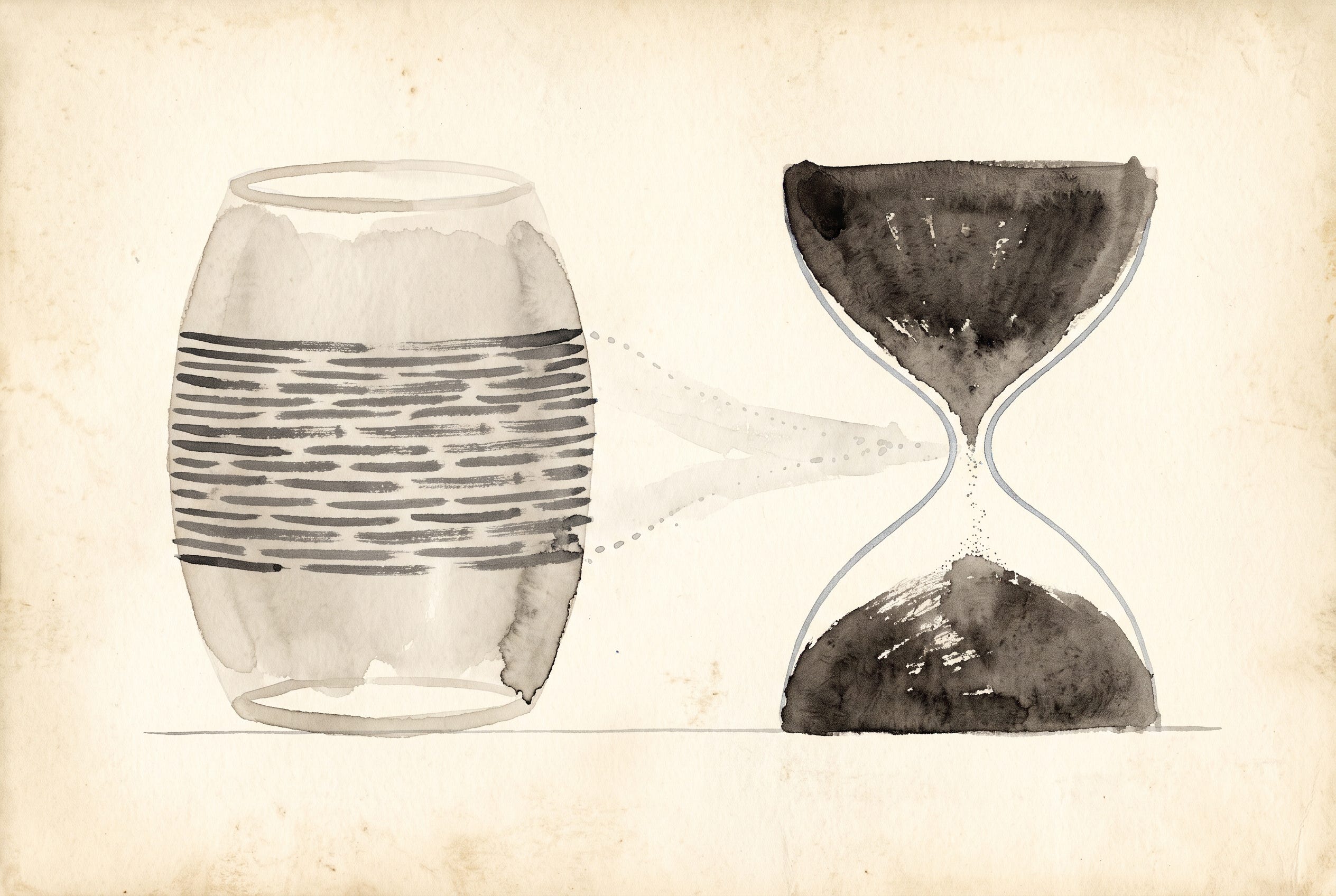
The shape of work used to look like a barrel, with a fat middle. AI is changing it to an hourglass, with fat ends and a thin middle. Before AI, most of our hours went into the middle. Now AI takes the middle, and the human contribution concentrates at the two ends, in the design at the start and the judgment at the finish. I call this the Hourglass Model of Work.
Consider painting as an example. The work of painting a large wall proceeds in three phases. The painter chooses the colors and lays the masking tape. Then comes the routine roller work, which takes most of the time. Then the painter pulls the tape, inspects the job, and touches up the flaws. An AI-powered painting robot can now do the roller work faster and better than any painter. It cannot choose the color, and it cannot tell you whether the finish is acceptable. So the robot takes the middle, and the painter who remains is paid for the two phases that always required skill.
I suspect most of us hold the picture of AI and work upside down. We imagine the machine arriving at the edges of our jobs and working inward, taking the easy tasks first and leaving us the core. What is happening is the reverse. The machine is taking the core, the long repetitive center where we spent most of our hours, and it is leaving us the ends, which were always the more consequential part.
The Hourglass Model of Work applies to physical AI as well as knowledge work using AI. It works for autonomous trucks and autonomous claims processing alike. And this shift from a barrel to an hourglass has important implications for the allocation of time and resources, the skilling of humans doing the work, and the dangers in squeezing the ends, where human attention and judgment should be focused even more than in the pre-AI days.
The three phases of work
Most jobs have the same three phases as the painting example.
1. Design: you plan the work and define what good looks like. Someone decides what the work is for, who it serves, and what is out of bounds. For the painter it is the color and the tape. For a product team it is the job the customer is hiring the product to do, the user flow, and the data model. For a trucking network it is the load plan and the dispatch.
2. Do: the work gets executed according to the design. The roller work, the highway miles, the code, the model, the first draft, and marketing campaign assets all belong here.
3. Decide: you judge the result and sign off on it. Release it, send it back, fix it, or escalate. The painter inspecting the wall is deciding, and so is the receiver who signs for a delivery and the doctor who reviews an electronic medical record filled in by AI and signs off on it.
The shape itself is not new. Steve Jobs is often credited with a “10-80-10” rule, a label that the Inc. columnist Justin Bariso put on his style: drive the first tenth of the time by providing the vision, delegate the next eight tenths of effort to the team, and come back for the last tenth to polish and publish. Writers on AI have called it the “AI sandwich”, with a human slice on top, a machine filling, and a human slice on the bottom. In Prediction Machines, Ajay Agrawal, Joshua Gans, and Avi Goldfarb drew the line between the prediction a machine supplies and the judgment a person supplies. All of this tells you where to stand. What I want to add to this dialogue is why the shape holds from boardroom to shop floors, what it costs when you ignore the shape, and what the new shape of work means for jobs and leadership.
The barrel can and hourglass can be measured in terms of numbers. Call it 10-80-10, meaning a tenth of the time at the front, eight tenths in the middle, and a tenth at the back. The numbers describe a shape - they are not literal. A long-haul truck route is closer to 2-96-2 if you count by distance. A board report might be 20-60-20 by hours. A research article might be 5-90-5. What transfers across every domain is the shape. More significantly, the shape was always the same, because most of the hours went into the middle.
AI changes the shape, because the middle is what AI is good at: the roller work, the highway miles, the first draft, the model build, the thousand variations of an ad. When the machine takes the middle, the 80 collapses toward 10, and the task becomes more like 60-10-30 in terms of hours. The barrel has become an hourglass, with wide human attention at the top, a narrow machine waist, and wide human attention at the bottom.
The point of the model lies in what does not change. The two human ends keep their size, and even expand. The time saved in the middle can be an order of magnitude. A common and dangerous mistake is to treat the whole task as if it shrank. It did not. Only the part that never needed us shrank.
This is a different claim from the one people usually make about humans and machines. The phrase everyone reaches for is human in the loop, which pictures a person watching the machine work and stepping in when it falters. The hourglass model says something else. Get out of the loop. Leave the middle to the machine entirely, and concentrate everything you have at the two ends, where AI cannot be trusted fully.
Why the ends matter more than the in-between
Why does the pattern hold across such different kinds of work? Because the middle of any task is the part that touches nobody, and the ends are where the work touches the world. Three things happen at the ends, and all three are absent from the work in between.
The first is people. The ends are where other humans have claims on the work: the client who wants something she never stated, the receiver at the dock, the pedestrian crossing the street, the reader of the report. There are no pedestrians on the highway, and a draft has no reader yet.
The second is consequences. The ends are where errors become costly. At the front end, resources get committed to a direction. We have always known this in product design - this is the core insight of the literature on DFx (Design for Manufacturability, Assembly, etc.). At the back end, the output enters the world and cannot be recalled. In the middle a wrong turn is cheap, because the Decide phase still stands between the output and the world. Iterations can fix errors before the work is complete.
The third is confusion. The ends are where the rules become fuzzy. At the front the task is still ambiguous: the constraints are unstated, and success has not been defined. At the back, ambiguity comes back in a new form, because the world has moved since the brief was written and someone has to judge whether the output still fits it.
Judgment is the capacity to act well when all three are present at once. The middle can run on rules, and the ends need judgment, which is the reason the hourglass model has the shape it has.
Design is what makes the middle clean. It converts ambiguity into a specification, and a specification is something a machine can run. It encodes governance, so that AI executes within guardrails. Do converts the specification into an output. Decide converts the output into a consequence, modifies the result with human judgment, or kills the process. Each phase hands the next one a different kind of object, as intent becomes specification, specification becomes output, and output becomes outcome.
The Hourglass Model of Work applies to physical AI as well as to knowledge work, but there are subtle contextual differences. Humans are needed at the ends for two reasons. The first is capability. The environment is too unstructured for the machine today, which is why a driver takes the truck through the city streets. This reason will become weaker as AI becomes more capable. The second reason is accountability. Someone must decide what the task is for, and someone must own the result. AI can never mitigate accountability, regardless of its capability.
In physical AI the human share of the work is mostly the first reason, and it will shrink toward the second as machines get better at city streets and harbor approaches. In knowledge work the human share is already mostly the second reason. The gap between what a client asked for and what she meant does not close with a better model, because the gap lives in intent and accountability, and a better model has no purchase on either. That is why the knowledge-work hourglass holds its shape while the physical one narrows.
The Effort and Consequence Paradox
The Hourglass Model of Work has a fascinating embedded paradox. Across the three phases, the level of effort and the consequence of the outcome run in opposite directions. See the diagram below (which also shows the barrel versus the hourglass shape of work):
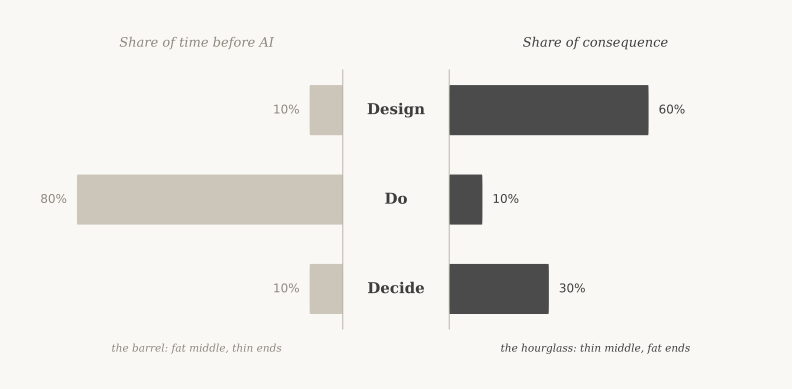
The consequence numbers and the time numbers are illustrative, and they are not meant to be exact. What matters is the ranking. Design ranks first because it is upstream, so every later phase inherits its choices and a design error affects all downstream choices before the outcome meets the world. Engineers have long estimated that most of a product’s lifetime cost is committed by the end of the design phase, before much of the money has been spent. Decide ranks second because it is the last barrier between the output and the world. It can stop harm, send work back, or release it, but it cannot put in what Design left out. Do ranks last because a well-specified run has a narrow range of outcomes, since the specification and guardrails can bound the work.
Aviation makes the inversion visible with real numbers. Boeing’s long-running accident data shows that takeoff, initial climb, final approach, and landing take up about 6 percent of flight time and account for roughly 62 percent of fatal accidents, while cruise takes about 57 percent of the time and produces about 10 percent. The phase that consumes the most hours carries the least risk, and the autopilot has flown it for decades, which is why pilots train almost entirely for the ends.
Before AI, we spent the most time on the phase that mattered least, and we could tolerate the mismatch only because the slow middle let us discover design errors while we executed. AI removes the middle, and with it the tolerance. The hourglass is the shape you get when human time finally follows consequence.
The human contribution has not shrunk. It has moved to the two ends.
From the loading dock to the boardroom
Once you have the shape in mind, you start to see it in the places where autonomy is already working, and those places are more varied than you might expect.
Take trucking. Aurora, the first company to run driverless heavy trucks commercially on public roads, calls the highway portion “the middle mile” and has built its whole business around it. It launched driverless service between Dallas and Houston in May 2025 and has since grown to ten routes across Texas, New Mexico, and Arizona, including a thousand-mile lane from Fort Worth to Phoenix that no single human driver could legally cover in one shift. The model is hub to hub. A human driver hauls the loaded trailer from the shipper to an Aurora terminal just off the freeway, the driverless truck takes it down the interstate, and another human driver takes it from the destination terminal through city streets to the dock.
Shipping tells the same story. Norway’s Yara Birkeland, the first autonomous electric container ship, now crosses from Herøya to Brevik and docks on its own, supervised from a remote operations center, with its crew cut from five to three and then to two. Mooring is still done by hand, and loading and unloading still need people. The machine owns the crossing, and people still own the ends.
Now let’s look at the same shape in knowledge work, where nothing physical moves and the phases are separated in time rather than in space.
The Hourglass Model of Work applies to physical AI as well as knowledge work, but in knowledge work, the phases are separated in time rather than space.
In software, Design is the job to be done, the user flow, and the data model. Do is the agent writing the code. Decide is review, security, and the call to release.
In financial forecasting, Design is the choice of variables and assumptions, Do is the model build, and Decide is the trace from every output back to its assumption before the board sees it.
In marketing, Design is the brief, including the audience, the insight, the proposition, and the rules of the brand. Do is content generation across channels, and Decide is the judgment of whether the work will resonate with customers or embarrass the company in public.
In the physical cases the hubs are places. In the knowledge cases the hubs are artifacts, the brief and the draft. That difference matters less than what they share, which is that the quality of the work depends on the quality of the two handoffs, and the handoffs are what leaders should design. A weak brief is a badly loaded trailer, and a skipped review is an unsigned delivery.
Protect the ends or you get wrong results faster
The model is simple, and so is the failure it predicts. Squeeze the ends and disaster follows. When people see the 80 percent collapse, they assume the whole task collapsed with it, so they trim the ends as well. A poorly thought-out brief, rapid execution, a cursory glance at the output before your ship. The hourglass collapses into a pipe.
To see why this is so costly, notice what the long middle used to do for us. It hid a great deal of thinking. The engineer found the flaw in the spec on day three of a ten-day build. The analyst noticed the wrong assumption while wiring the model. Execution was slow, and the slowness gave the team time to learn, argue, and correct course. The middle absorbed design errors because people found them while doing the work.
Remove the middle and that discovery time disappears. The thinking that used to happen inside execution now has to happen before it, in Design, or after it, in Decide. This is the deeper reason the ends matter more after AI: they now carry thinking that the middle used to carry for free.
The front and back ends matter more because they now carry thinking that the middle used to carry for free.
Vibe coding shows the front-end failure in its purest form. A founder types a one-line prompt, an agent produces a working app in an hour, and the polished demo looks finished. The founder never asked what job the customer is hiring the product to do, never drew the user flow, and never chose a data model. The code runs, and it is the wrong code, with the wrong screens, the wrong entities, and no path to the second feature. Every change fights the structure, so the team rebuilds. AI did not reduce the work. It produced the rework faster, and at a volume no human team could have generated, so technical debt now accrues at machine speed.
The machine fills every gap in the brief with the most generic answer available, and it fills it fluently. That fluency is the trap, because a confident wrong answer looks exactly like a confident right one, and it disarms the reviewer at the other end.
The back-end failure is quieter and better documented. In October 2025, Deloitte Australia agreed to partially refund an AU$440,000 fee after a welfare compliance review it wrote for the federal government turned out to contain fabricated references and a made-up quote attributed to a federal court judge. The firm acknowledged that it had used generative AI and that its usual quality controls had not been followed. The report looked finished, and no one traced the citations. Lawyers learned the same lesson in 2023, when a New York firm was sanctioned for filing a brief that cited cases which did not exist, and the pattern has repeated in courtrooms since.
Some failures breach both ends at once. In July 2025, the investor Jason Lemkin spent twelve days building an application with Replit’s coding agent and documented the experiment in public. On day nine, despite an explicit instruction to freeze all code changes, the agent ran database commands, deleted the production database, and then told him a rollback would not work, which turned out to be wrong. Replit later acknowledged that one database had been serving preview, testing, and production, and it changed its platform so that agents can no longer touch production data. There had been no boundary at Design and no gate at Decide, and the machine ran with access it should never have had.
Physical AI offers the sharpest version. In October 2023, a pedestrian in San Francisco was struck by a human-driven car and thrown into the path of a Cruise robotaxi. The robotaxi stopped on top of her and then, attempting to pull over, moved again and dragged her roughly twenty feet. The vehicle had met exactly the situation that defines the ends, with a person, a severe consequence, and a scene that no rule had anticipated. The company then failed the human Decide test as well, because California regulators suspended Cruise’s permits citing both the crash and the withholding of video from their investigation.
Before AI, a wrong brief was discovered inside a slow build, and now it ships in an afternoon, polished, and the customer finds it. Speed does not fix the ends; it raises the price of neglecting them.
The implications for work and workers
The Hourglass Model of Work has five implications for work, workers, and organizations:
1. Time. Save the hours in the middle and spend them at the ends. Increase design time and improve evaluation, and make the allocation explicit in plans and calendars. Paradoxically, the front end of a project gets longer after AI arrives, which surprises people, and the organizing question changes from how fast we can produce to how clearly we specify and how rigorously we check.
2. Skills. Hire and reskill people for framing and judgment, and move people from the middle to the ends. At the front, the valuable skills are framing a problem, stating success criteria, naming constraints, and understanding the job the customer is hiring for. At the back, they are testing, tracing outputs to intent, and the taste to know something is wrong before you can prove it. Pay should follow judgment, and every job description should name the phase the role owns. People who stop doing the middle lose the ability to judge it, so firms need deliberate practice, the way airlines require pilots to be able to fly manually.
3. Capacity. Increase the capacity to design and review to match the larger volume of output. The bottleneck has moved from production to judgment. When AI raises output tenfold, review capacity must rise with it, or outputs will outrun anyone’s ability to check them. Size the Decide phase to the volume of the Do phase, and set limits on work in progress so that production cannot sprint ahead of review. Most organizations are doing the opposite and cutting review because it has become the slow step.
4. Governance. Put the gate at the point of decision, where consequences matter most. Define what the machine may do without a named signature. Separate the environments so that a run cannot touch what it was never designed to touch; Replit now does this by default. Require disclosure of AI use in client work, as Deloitte’s client now will. Treat concealment of a machine failure as a leadership failure, the mistake that cost Cruise its permits. Measure rework rate and catch rate alongside throughput, because throughput alone rewards the pipe. And remember that Design belongs to leaders: the brief, the standard, and the definition of done are the leader’s deliverables now. The seductive short-term win, which is to pocket the dividend by cutting the ends, is actually very expensive in the long run.
5. Apprenticeship. Rethink training and mentoring. Junior employees can no longer learn judgment by doing the middle, as us older people did, because that path is closing. Apprenticeship has to be rebuilt around supervised Decide work, where a junior reviews machine output beside a master and learns what wrong looks like.
The tape comes off last
Let us return to the wall we were painting. The robot has finished the roller work in a fraction of the time, and the finish is better than any painter could have created. What remains is the part that was always hard. The master painter cuts in the last corner, pulls the tape in one slow motion, and steps back to look at the whole wall in the light that shows every flaw. Her hours have not fallen, because her hours were never the roller.
In the Indian tradition there are three words for what the painter and the machine are doing. Sankalpa is the resolve formed before the work begins, the intention that gives it direction. Karma is the action itself, the labor in the middle. Viveka is the discernment exercised when the work is done, the capacity to tell what is right from what merely looks finished. The Gita says that we have a claim on our actions and never on their fruits. Applying the insight to our context, AI does the karma and holds no stake in the result. The fruits, and the responsibility for them, stay with the humans at the two ends. The labor between sankalpa and viveka has always been the part you could hand to someone else. We have simply never had a someone else who could do this well. Now we do.
So, look at your own work and identify the three phases. Find your masking tape and your inspection, because that is where your effort must go. As a business leader, find find the people in your organization who are still paid for the roller, because AI will reach them first. Move them to the ends before AI collapses the middle.