


It is graduation season, which means I have been sitting through many graduation speeches by students. They tend to converge on the moment when the speaker starts thanking. Parents who supported. Teachers who inspired. A partner, a mentor, a grandmother in the third row. The thanks are heartfelt. But they are always too little and too late. Decades of giving acknowledged in ninety seconds at a podium. As I sat through these ceremonies, I found myself thinking about gratitude. Not the ceremonial kind, but the everyday kind. What we owe, to whom, and how we ought to pay it.
Once you start paying attention to it, a paradox emerges. We thank the barista who casually hands us a cup of coffee, but we go strangely quiet around the people who are the wind beneath our wings. The waiter who fills the glass once earns a warm word; the spouse who has filled it for twenty years merits nothing. We remember to thank the cab driver who got us to the graduation venue in time, but we forget the parents who paid for the degree being collected that day. We shower gratitude on people who do small favors for us, but we withhold thanks from those we owe much more.
This paradox is worth reflecting on because gratitude is a gift that leaves both parties richer. And it costs nothing to give. We waste it anyway. We waste it in three ways. We never truly acknowledge what we are given; when we do feel it, we keep silent; and even when we do express our gratitude, we do it poorly. I call these the gaps of experience, expression, and form.
Three gaps in being thankful
The first gap in gratitude is experience. Before gratitude can be voiced or shaped, it must be felt. We fail to acknowledge the gifts that we receive in two ways. First, the gift never registers at all; it arrives, we absorb it, and it never crosses our minds that anyone gave us anything, because what comes to use doesn’t look like a gift. It just becomes an expectation. The subtler and far more common failure is that we register the gift, but we feel nothing. We know the dinner was cooked, the favor was done, the sacrifice was made. But the knowledge of the gift is filed away as a fact, instead of becoming a warmth that moves through us. Awareness is only the doorway. Gratitude is what happens when awareness is allowed to ripen into feeling, and we often stop at the doorway.
The second gap is expression. Often, we do feel gratitude, but we simply never let it out. We tell ourselves the other person surely knows already, or we hold it back for a better occasion that never quite arrives. Between people, gratitude that is felt and never voiced does little good, because no one can read a heart, and a kindness that goes unacknowledged slowly stops being offered.
The third gap is form. Here we manage to express something, but we use the wrong vehicle. We fire off a text when the occasion called for a phone call. We mumble a vague “thanks for everything” when one precise sentence would have meant far more. We can overshoot too, lavishing thanks on a trivial favor until the other person feels they now owe us something. The feeling behind the thanks may be right, yet if its form factor is wrong, what reaches the other person comes through distorted or diminished, if it reaches them at all.
These three gaps do not occur in a tidy sequence. You can skip straight to the last of them and produce the form of gratitude with nothing inside it. The thank-you tossed over a shoulder, the dutiful note written because a note is expected. They have the shape of gratitude but have no substance. Form without experience is hollow. Most people can feel the hollowness even when they cannot name it. We must work to connect the feeling and the saying and the shaping, so the outer thanks faithfully echo the inner experience.
So, we feel too little of what we are given, voice less than we feel, and misshape what little we voice. The craft of gratitude lies in working through these three gaps in turn. Let me take them in order: what is worth being grateful for, whom we owe, and how the thanks ought to be delivered.
What deserves your thanks
Not all acts of kindness carry the same weight, and gratitude that treats them as if they did is lazy. The true weight of a gift is measured on four dimensions.
The first is sacrifice, the cost to the giver in time, money, risk, or emotional labor. The second is impact, the size of the benefit to you, anywhere from a trivial convenience to a transformed life. The third is discretion, how freely the act was chosen rather than owed. The cab driver who drops you on time is doing a paid job; the friend who sits with you through the worst night of your life had no reason to come, but she did anyway. The fourth is constancy, the reliability and frequency of the giving. A single heroic rescue counts for a great deal, but the undramatic decade of hundreds of small dependable acts count even more.
You can hold these together as a rough mental model:
True worthiness ≈ sacrifice × impact × discretion × constancy
Two further forces bend how much a gift registers on us, and neither of them has anything to do with how much it is worth.
The first is habituation. The more often a thing is given, the less we see it. We notice the first dinner a partner cooks for us; by the six-thousandth it has faded into the familiarity of ordinary life, and we stop registering it as anything at all. Frequency ought to deepen our gratitude, since it means we are being given more, and in practice it does the opposite and dulls us to the giving.
The second is visibility. We tend to thank what we can see. A wrapped present gets noticed and acknowledged; quiet presence does not, because there is nothing to point at. The person who simply shows up and stays, asking for no credit and producing no object, is often doing the most valuable thing anyone does for us, and it is precisely the sort of thing that slips by unseen.
Felt gratitude ≈ worthiness × visibility ÷ habituation
The gap between those two lines is the experience gap, and it accounts for the paradox I began with. The acts that matter most tend to be the steady, undramatic ones, which are the acts that habit dulls and invisibility hides. The most valuable gifts in a life are camouflaged by their own reliability, and they tend to come from the people standing closest to us, which is why we are the worst at feeling grateful to them.
Put the ordinary scenes against this model and they come into focus. The dinner a spouse cooks carries little visible drama, but it is frequent and freely given, which is why it deserves far more notice than its quietness ever draws. Parents funding a degree give heavily on every count, sacrifice and impact and free choice together, and the graduate thanking them from the stage is, for one moment, finally seeing it clearly. The professor who mentors a student across a career gives on all four counts and is usually thanked years too late, if at all. The stranger who walks an old man across a street acts under no compulsion whatsoever, and that is the whole reason it moves us. And the friend who turns up in the middle of your worst night combines the deepest impact with the purest discretion, which is why it is the kindness none of us ever forget.
Whom to thank
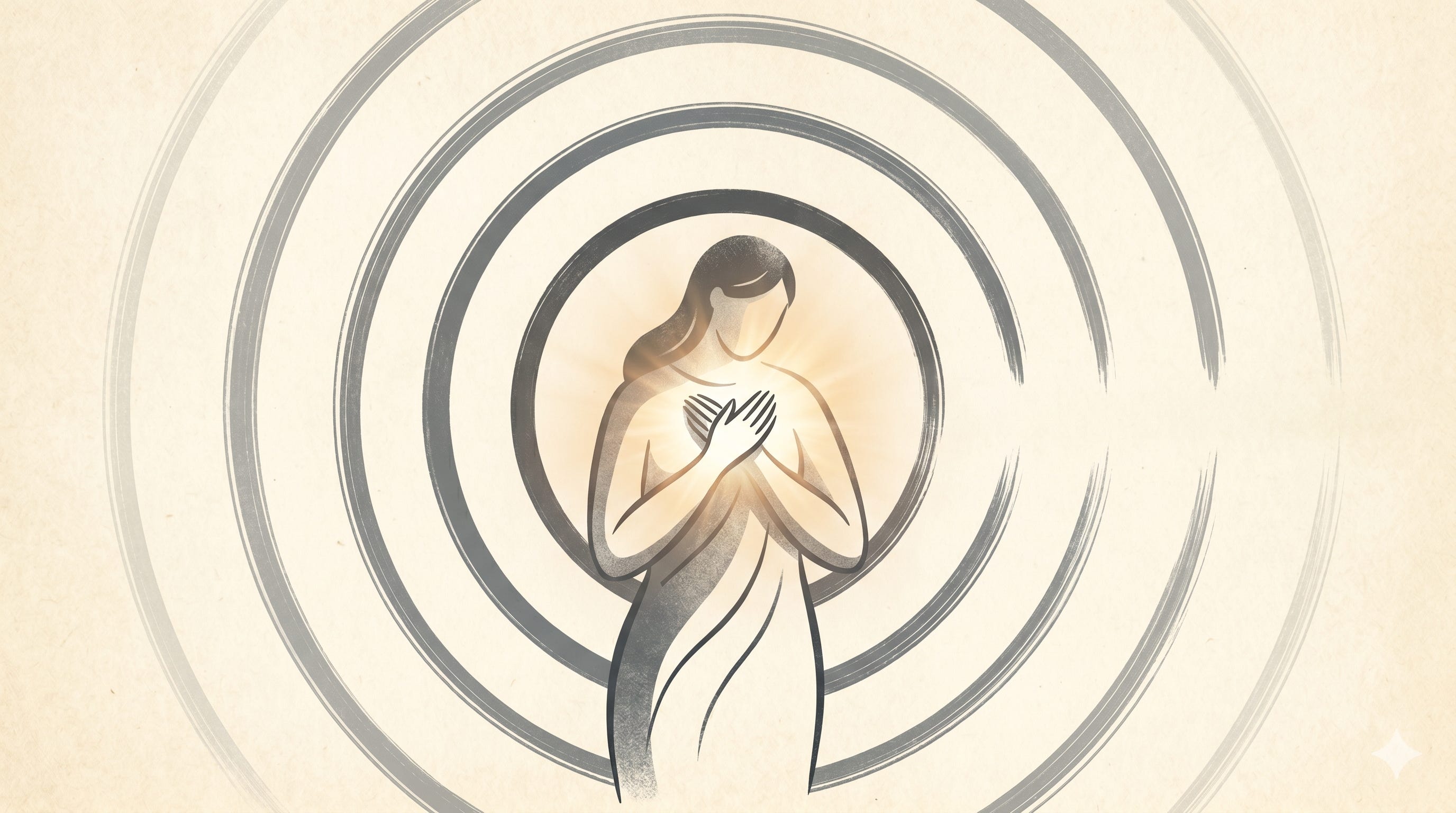
Picture the people you owe as a set of rings. The easy version of this map sets the strangers at the center and dear ones at an outermost rim. The truth runs the other way. At the very center sit our close ones - a spouse or partner, parents, children. Around them sits the ring of close friends and chosen family. Further out are the teachers and mentors who shaped how you think. Further still lies the broad human web of near-strangers, the cab driver, the shopkeeper, the crew that paved the road you drove on. And at the outermost edge, the benefactors you will never name, the donor behind a scholarship, the politician who went to bat for your constituency.
The cruel joke buried in this map is the proximity paradox. Our gratitude tends to be strongest toward those at the outer edge and weakest toward those close in, which is the reverse of what the facts warrant, since the nearer something is, the more of our life it is quietly holding up. We thank strangers readily, partly because their kindness is visible and the social script demands it, and we let the habit wither at home, where long familiarity has worn away any sense that something is even being given. Closeness breeds a low-grade entitlement. We start to treat what the people nearest us do as the baseline condition of our lives rather than a gift. And the law does not stop at the family. It runs all the way to the center, to the giving that is nearest and most constant of all, which is exactly the giving we are least able to feel. We will return to that center at the end because it is where the whole thing has been heading.
Which means the discipline runs against the grain. The gratitude most worth spending on purpose is the kind that has gone dormant through sheer repetition, owed to the people whose giving we long ago stopped noticing, rather than the easy gratitude we feel toward a stranger or a passing favor. As a rule, the thank-you that takes the most effort to remember is the one most overdue.
How to thank
Gratitude has a whole repertoire of forms, and we habitually reach for only one or two of them. The range runs from the silent and internal, a private act of noticing, through the word spoken in the moment, the phone call, the handwritten note, the longer letter, the kindness returned in deed, the gift, the passing of it forward to someone else entirely, and on to prayer or ritual, which needs no human recipient at all.
The governing principle is fit. Good gratitude matches the act it answers along five dimensions.
It matches on intensity. A muttered thanks for something life-changing falls well short of what was given, while an over-large gesture for a small favor tips the other way and quietly saddles the recipient with a sense of obligation, which is the last thing you intended.
It matches on intimacy. The closer the relationship, the more the chosen form should cost you something. A quick text settles a stranger’s small kindness perfectly well, yet the same text sent to a parent in return for years of sacrifice reads as thin, almost dismissive. The effort you put into the form is itself part of what you are saying.
It matches on timing. Gratitude has a short half-life. A note the next morning still carries the warmth of the moment that prompted it, while the identical words a month later arrive as an afterthought, however sincerely meant.
It matches on specificity, which is where sincerity shows. A blanket thanks for everything has been said so often it now carries almost nothing. Say instead that you remember them sitting with you on the floor of the hospital corridor at two in the morning, and the thanks carry real weight, because it proves you were paying attention the whole time. Specificity is the evidence that the gift was truly seen.
And it matches on medium. A thing said to someone’s face weighs more than the same thing in a voice over the phone, which in turn weighs more than ink, which weighs more than a screen. Reach for the heaviest medium the occasion can carry.
Every way of getting this wrong is just fit inverted: too little for a great deal received, too much for a trifle, the right thing said too late, said too vaguely, or sent through too slight a channel. When our gratitude fails, the feeling was usually there all along. What failed was the delivery.
The harder question: should the receiver expect thanks?
Now turn the whole thing around. Until now, I have been writing from the position of the one who owes gratitude. But we spend just as much of life on the other side of the exchange, giving and giving and quietly waiting for a thank you that often never comes. What are we entitled to expect? And what are we to do with the partner, the friend, or the child who seems constitutionally unable to say thank you?
There is an old Hindi proverb that disposes of half the question in five words. Neki kar, kuen mein daal. Do the good and drop it in a well. Do the kindness and let it fall out of sight. Forget it was ever done. Expect nothing back.
The Gita gives the same counsel in its best-known verse. Karmanye vadhikaraste ma phaleshu kadachana (Bhagavad Gita 2.47). You have a claim on the action, never on its fruits. Do the work and release the harvest. This is not only spiritual advice; it happens to be psychologically precise. The moment you begin to expect thanks; you have put a price on your kindness and turned a gift into an invoice. An unpaid invoice, left to sit in the heart, accumulates the interest of resentment. And the expectation corrupts the act of kindness because it was never a gift to begin with, just a loan.
Fine, we should expect nothing as the giver. But the proverb leaves a harder question unanswered. What about the chronically thankless partner, the grown child who treats a lifetime of gifts as their entitlement, the friend who has never once thought to say thank you? Do we go on pouring into the well indefinitely and call the resulting self-erasure a virtue?
The resolution lies in three distinctions.
The first is that what discipline asks of the giver and what it asks of the receiver are mirror images of each other, and we are usually called to be both at once. From the giving side, the counsel holds: expect nothing, release the outcome. From the receiving side, the counsel reverses completely. There you should consider yourself to owe a great deal, and you should work at noticing it. A grown-up carries both at the same time, generous without keeping score, grateful without having to be reminded. The trouble starts when a person gets the two backwards, wanting credit for the little they hand out while quietly assuming the much larger amount they take in. This asymmetry leads to entitlement and takes us away from living a grateful life.
The second distinction matters most for the thankless partner. Release the act, but do not release the relationship. Letting go of the fruit is exactly right for any single act, and for strangers who pass through your life once and are gone. It is the wrong stance toward a living bond. When chronic ingratitude becomes the drumbeat of a marriage or a long friendship, it tells you that the relationship is imbalanced or toxic. You must not keep pouring yourself into such one-sided arrangements. The line I would draw is this. Let go of the need to be thanked and hold on to your self-respect. Give up the first and you keep your peace; give up the second and you have taught the people around you that you can be treated as furniture.
The third distinction is the one that frees a parent most. Gratitude in a child is something you cultivate, and it is not something the child owes you. An ungrateful grown child is, at least in part, a result of how gratitude was or was not taught, and the parent who demands it as repayment has misread the whole task. You do not raise a grateful child to be thanked. You do it because gratitude is a capacity the child will need to flourish, to sustain every relationship ahead of them, to guard against the slow corrosion of taking everything as given. Looked at that way, teaching your child gratitude is simply one more thing you are giving them. The instant you want it for their sake rather than from them for yours, the disappointment loosens its hold, and you find yourself back at neki kar, kuen mein daal, this time inside your own home.
The crescendo: within every giver, the Giver
We have travelled a fair distance through the tangible by now. Dinner, tuition, a hand offered across a street, a friend who stays through the dark. Within all these scenes, though, sits a deeper question that turns gratitude from a social skill into a way of living.
Who gave the cook her hands? Who gave the parents the years and the means with which to give in the first place? For that matter, who gave the friend the breath to sit beside you through the night? Within every human giver lies the gift that makes any giving possible at all, handed to us one unearned breath after another. The Sikh Gurus were precise on this point, and on its geography. They did not place the ultimate object of gratitude far off at the edge of things. They placed it within, ghat ghat, in every heart, the Formless Divine, Nirankar, the one Data, the Giver nearer to you than your own breath and the source from which every other gift flows. This is the center of the rings I drew earlier, and it is the reason I drew them inward rather than outward.
Now the proximity paradox closes its circle. If the law is that the nearest and most constant giving is the hardest to feel, then the giving of the Formless is its perfect and final case. Think about what is being given here and how often. Not dinner once a day or a rescue once a decade, but a breath, now, and another, and another, and another, and another, twenty thousand times before tonight, each one unbilled, unasked, and undeserved. There is nothing in all human experience more constant than that, and so there is nothing we take for granted more completely. What could be more habitual than a gift that arrives every few seconds of your life? The very frequency that should overwhelm us with gratitude is precisely what renders the gift invisible. We notice the breath only when it is taken away, gasping for the thing that was free a moment ago.
Guru Nanak highlights the asymmetry in a single line of the Japji Sahib. Dedaa de lainde thak paahi (Guru Granth Sahib, Ang 2). The Giver keeps on giving, and those who receive grow tired of receiving. The claim is not that we are too weak to repay the Divine. It is stranger and humbler than that. We are too worn out even to keep taking. The flow of breath and mornings and second chances come so steadily that the one receiving tires long before the one giving does. Our difficulty with the deepest gratitude has nothing to do with whether we can afford it. We simply cannot keep pace with the rate at which the gifts arrive.
Guru Arjan presses the same truth into a question that is a moral reckoning. So kio bisrai jin sabh kichh dia (Guru Granth Sahib, Ang 289). How could you forget the One who gave you everything? He sets it inside a litany of the body’s own faculties: by whose grace do you hear, see, taste, draw breath? We will thank a stranger warmly for a small courtesy and forget the One who lent us the very senses we used to register the courtesy in the first place. In the Guru’s framing this forgetting is no mere lapse of manners; it is spiritual blindness, the ingratitude at the heart of every other ingratitude.
And here the breath comes back into the argument because the Sikh tradition ties remembrance directly to it. Saas saas simro Gobind, with every breath, the Gurus say, remember the Giver. Gratitude is meant to keep time with breathing itself, the nearest and steadiest and least noticed gift we hold turned into the rhythm of devotion. What you have done thousands of times today without a flicker of attention becomes, in a contemplative life, twenty thousand small acts of thanks.
Notice what has quietly happened to the three gaps as we moved inward. Out toward the edge, where the giving is human, form carried much of the weight, because another person had to receive thanks, and a kindness left unacknowledged withers. The further in we go, the less the form matters and the more the experience must deepen. A nod to the cab driver asks almost nothing of us inwardly. Thanks for a life pulled back from the brink of an illness asks a great deal more, and anything glib only cheapens it. Gratitude to the Formless for existence itself asks for a depth of feeling that no words can express. This far in, the words run out, and their running out is no failure of expression. The careful phrasing, the right medium, all the machinery we worried over earlier, falls away, and what remains is a wordless interior fullness that needs no recipient to complete it. The rule I gave earlier, that gratitude felt and never voiced does little good, does not reach this far in. The deepest gratitude of all may never be spoken aloud, and it loses nothing for the silence, provided it is truly felt rather than merely assumed.
There is one further turn, and it goes deeper than the rest. At its innermost, gratitude dissolves the very idea of a debt. As Kabir puts is in a profound doha: Mera mujh mein kuchh nahin, jo kuchh hai so tera; tera tujh ko saunpte, kya laage mera. Nothing in me is my own; whatever there is, is already Yours; so, when I hand Yours back to You, what has it cost me? This is gratitude reaching its vanishing point. Out at the edge, I thank you for what you gave me, on the assumption that I owned the gift and now carry a debt for it. Closer to the center, it grows clear that I never owned any of it. The breath was never mine to keep, and the life was on loan from the opening instant, so returning it in thanks costs me nothing at all. The ledger of debts and repayments that has run through this whole essay simply closes, and what is left is pure offering.
What is left at the very end is acceptance. Guru Arjan composed in his final days, under torture, and what came out of him was not a protest. He wrote Tera kiya meetha laage (Guru Granth Sahib, Ang 394). Whatever You do tastes sweet to me; Nanak asks only for the treasure of Your Name. It gives thanks for the entirety of what arrives, the bitter portions included. Gratitude at this point is less a reaction to good fortune than a standing disposition toward existence itself.
Living in gratitude
So, the whole thing turns out to be a journey, and it runs in one direction only, inward, toward the center of those rings, drawing closer step by step to what was nearest the entire time. At the outer edge you thank people for things, for the tangible gift you can hold up and point to, and here the form of the thanks carries most of the weight, the medium and the timing and the words. A step inward you thank them for acts and for sheer presence, for a faithfulness that arrives in no wrapping and announces itself in no way at all, and already the feeling must run deeper than any phrase you could pin to it. Closer still you let go of your own expectation of being thanked, and you give into the well. At the center you find yourself grateful to the Giver for existence itself, for the breath you never earned, and there the words fall silent altogether. The strange logic of it is that the deeper in you go, the less you need to say and the more you need to feel. Form drops away first, then expression itself, and what remains is pure experience, the debt long since dissolved into offering and the offering settled into a gratitude that no longer needs to announce itself.
The encouraging part, and the reason that this is within reach of an ordinary distracted person with a full calendar, is that gratitude is free. It costs nothing to produce and never runs out. It is also the one debt whose repayment leaves the debtor lighter rather than poorer. Most obligations weigh more on us the longer they go unpaid. This one does the reverse. The more of it you give away, the freer you tend to feel.
It may take us a long time and deep spiritual evolution to thank the Giver for every breath we are gifted. But we can begin closing the three gaps in gratitude today. Feel a little more than you let yourself feel yesterday, not merely notice, especially toward the faces that long familiarity has rendered invisible. Then say the thing aloud rather than filing it away for a better occasion, with some specificity, soon, and in a form that costs you something. Some of it you will not be able to say at all, and that is fine, so long as it is genuinely felt and not quietly assumed. If you do this, you will heighten the awareness that within the cook and the parents and the teacher and the friend, and within you, is the one Giver who keeps on giving, closer and more constant than any of them, long after the rest of us have grown too tired to keep receiving.
Start anywhere. Start with the next breath. It is, after all, a gift, and it just arrived, right on time, asking nothing in return.
Thanks a lot for a comprehensive article on this important element of being human--both ways. This idea stays in my mind, "Nothing in me is my own; whatever there is, is already Yours; so, when I hand Yours back to You, what has it cost me?"
The thank you that takes the most time to remember is the one that is most overdue
--This line has stayed with me.