


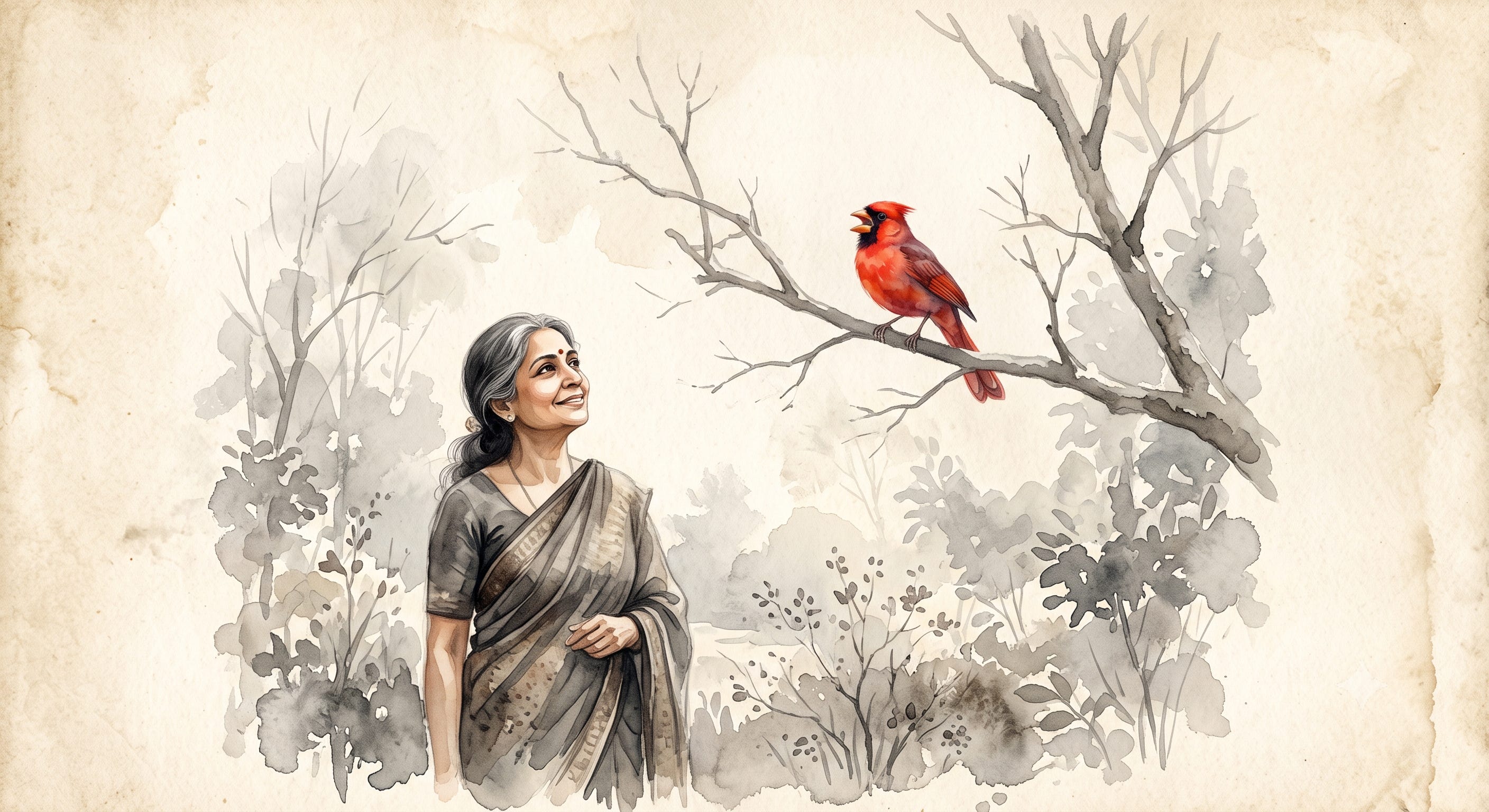
My wife knows every bird in our garden. She feeds them each morning and talks to them individually as they arrive. She knows the cow bird with a broken foot and keeps an eye on her recovery. She knows the squirrel with the bald patch on his head. She knows which birds and rabbits and sparrows have babies this year and how the babies are coming along. And she swears that the male cardinal who lives in our backyard knows her and sings for her when she steps outside. I used to smile skeptically when she told me this. But I have seen the bird hop closer and sing to her so often that I have begun to believe.
Her empathy goes well beyond the birds and animals in our backyard. She waters the plants and talks to them as she goes. She has full conversations with our cat Mishti, and I marvel at how precisely they communicate with each other. When we leave the hotel room at the end of our stay, she thanks the room. She drives our children to the airport and from the airport, and me too, at whatever hour the flights demand. She is the shoulder that everyone cries on: close friends, distant friends, people who are barely friends at all, but who know that they can knock on her door when trouble arrives.
And she is collapsing under the weight of it.
Empathy takes a great deal out of a person; anyone who has given it with the intensity she does knows the exhaustion it leaves you with. It is exhaustion that saps your energy and taxes your soul. And yet I cannot ask my wife to change. In fact, she should never change her empathic behavior. Empathy is not a bad habit she has; it is who she is. It may be the purest expression of what makes any of us noble. To blunt it would not be self-care. It would be amputation. So, the question is not how to feel less. The question is how to carry tenderness without being crushed by it.
When my wife sits beside a grieving friend, two things happen inside her. One is the caring itself, the warmth that moves toward the other person. The other is the absorbing: her own body taking on the grief, feeling it as if it were hers, carrying it home in the car and up to bed. The first is love. The second is the toll. Researchers who have studied compassion in trained meditators have found the two run on different circuitry: feeling with someone lights up the pathways of pain, and it depletes; feeling for someone lights up the pathways of warmth, and it enriches you. Caring is renewable. Absorbing is not. What wears out the tender-hearted is not the love. It is the borrowed grief that was never theirs to keep.
The tradition I was raised in has profound wisdom to offer on this dilemma. It will not let us harden, and it will not let us drown. In the Japji Sahib, Guru Nanak names compassion as nothing less than the foundation of the world:
ਧੌਲੁ ਧਰਮੁ ਦਇਆ ਕਾ ਪੂਤੁ ॥ ਸੰਤੋਖੁ ਥਾਪਿ ਰਖਿਆ ਜਿਨਿ ਸੂਤਿ ॥
Dhaul dharam daiaa kaa poot; santokh thaap rakhiaa jin soot.
The mythic bull that bears the world is dharma, born of compassion; and it is contentment that holds the thread in place. (Japji Sahib, Ang 3)
Compassion, daya, upholds everything; a world without it collapses. But notice what steadies the bull: santokh, contentment, the quiet sufficiency that asks nothing back. Compassion is not meant to stand alone. Unaccompanied, it shakes under the load. Paired with a contented heart, it can hold up the earth.
Guru Nanak also left us the picture of how. In the Sidh Gosht, Nanak describes the one who lives fully in the world without being pulled under by it: jaise jal meh kamal niraalam, murgaaee nai saane, as the lotus lives in the water and remains untouched, as the duck swims the stream and rises with dry feathers (Ang 938). Notice that neither creature avoids the water. The lotus is planted in the pond, not beside it. The duck spends the whole day swimming. The teaching is not withdrawal. It is immersion without saturation. Join in the sorrow of others up to your neck but do noy let it soak into your being. Feel fully. But shake it off, like ducks shake off the water from their feathers.
What does this look like on an ordinary Tuesday, for a woman with a heavy load of other people’s troubles? Many little things, none of them grand. Boundaries, which are the banks of the river: they do not shrink the water, they are what lets it keep flowing; the visit that ends when it ends, the phone that goes quiet after a certain hour. Releasing what she has heard once she has truly heard it, setting the day’s collected sorrows down at the door the way she sets down her keys. Replenishment, not as indulgence but as maintenance of the body and soul everyone else depends on. And, hardest of all for people like her, receiving. Letting someone else drive her to the airport now and then, letting a friend carry her troubles for an hour, allowing the current to run the other way. The people who love an empath must sometimes insist on this because she never will.
None of this asks her to be less kind. The goal is not to love less. It is to lose less of herself in the loving. Keep the tenderness and shed only the toll. Care like the lotus: rooted in the pond, open to all of it, unstained.
Watch her in the garden in the morning and you notice that the tending runs both ways. The birds she feeds are feeding her something back. The plants she talks to are the hour in her day when nothing is asked of her in words. The garden is not one more claim on her empathy; it is where her empathy is answered, a whole world that receives her love and returns it quietly. Every empath needs such a place, a corner of life where the giving and the getting are the same act.
The cardinal, she insists, sings for her. I have stopped doubting it. A heart that pours out that much into the world should not be surprised when the world, in its own voice, sings back.
Mohan, you have explained a very difficult concept very lucidly. Your grasp over Gurbani is a gift. I look forward to your writings
Absolutely beautiful Mohan- thank you so much for sharing. What a lovely reflection and beautiful tribute to your wife. You are both so lucky to have each other.