


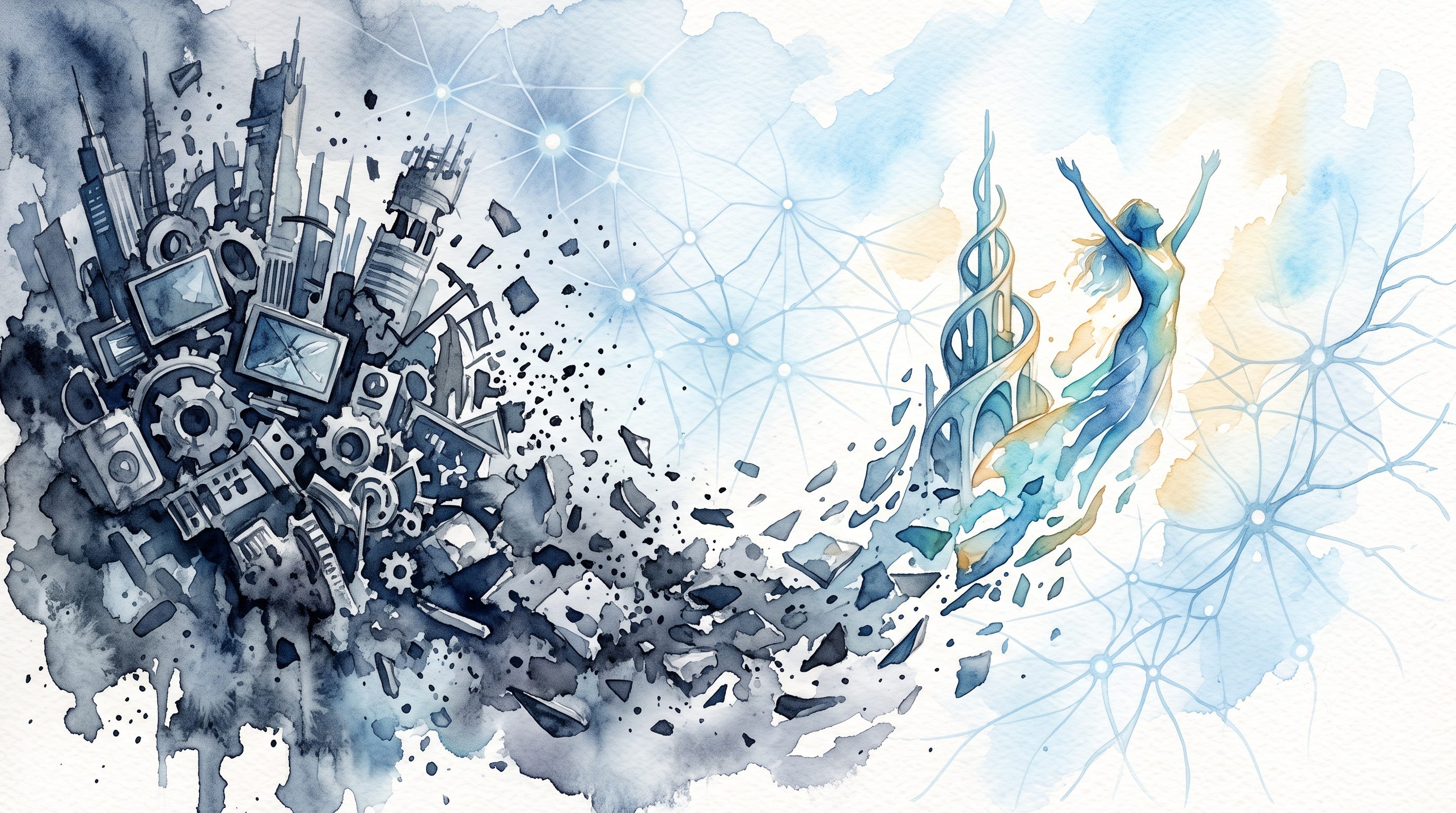
I have been a student of technological change and disruption for thirty five years. I have observed a pattern. Every transformative technology embodies the oxymoron of “creative destruction”. On the one hand, its offers the promise of dramatic value creation. On the other hand, it holds the peril of destruction of jobs, products, and companies whose legacy is threatened by the disruptive technology. Here is a painful reality of creative destruction - destruction precedes creation. Forest fires can rejuvenate a forest, but they first burn down what exists.
AI is fast approaching its destructive peak. There will be a new dawn, and AI can get us to a better place. But creation requires intent. And effort. Unlike destruction, which happens by default. Silently. In this article, I reflect on the destructions of AI that are happening today, and can get worse if we do not act. I also offer the cure for the disease - how to rise and fight against the destructions as individuals, enterprises, and as a society.
I present the arguments in two movements. First the destruction, painted starkly, because we must clearly see the destructive potential of AI. Then the rise, which is the inspiring and intentional response. The two movements are paired by design. As AI destroys the value in legacy software, it creates opportunities for a new class of software companies. When AI eliminates jobs through “AIoffs” (layoffs attributable to AI), it also defines the contours of the jobs that will be created. And as AI taxes our environment and threatens our humanity, it forces us to elevate our responsibility to the planet and to human welfare.
I. The Destructions of AI
Let’s begin with the destruction happening in full view. The value of software is collapsing. For a generation, an enterprise software company was protected by its features. You built something hard, shipped it, and the sheer difficulty of building it again held competitors off. That wall is coming down. A model now writes working code from a prompt, and reads a mature codebase to find the bugs its own authors missed. Enterprise software that was a fortress becomes a series of agents and prompts. Screens and flows that took years to assemble can be created in an afternoon by someone who could not have written a line of code last spring. AI has destroyed the moats of SaaS companies and even first generation AI companies like Jasper and Figma. Drain the difficulty out of building, and the value that derived from the difficulty disappears. The so-called SaaSocalypse is real, and it will get worse.
From the software, the damage spreads to the people who built it. The first to feel it work in the routine middle level of knowledge work, the tasks precise enough to specify and repetitive enough to be worth handing off to AI. The support rep who fielded the same customer questions, the analyst who rebuilt the same deck, the developer who typed the same boilerplate, each now watches AI finish in seconds what formed the core of their 60 hour workweeks. There is a deeper cut beneath the obvious one. Junior roles were never only about what they produced. They were the rungs people climbed toward judgment, the years of doing the easy thing that taught you, slowly, how to do more complex things. Cut off the bottom rungs of the ladder, and you have to wonder how anyone will reach the top in the future.
Below the lost jobs sits a subtler loss that troubles me deeply, because it happens inside us. Thinking is work, and AI excels at taking work away. Ask it to draft your argument, and you skip the labor of building the argument, which was where you would have found out what you actually thought. Ask it to summarize the book, and you skip the reading that might have enlightened you. The catch is that the labor was never dead weight. Wrestling a problem to the ground from first principles is what grew your judgment to begin with. Take that wrestling away, and you keep the answers while the cognitive muscles that produced the argument atrophy. A generation could grow fluent at prompting while forgetting how to think.
Beyond people and companies is the cost of AI that we do not see, because it sits in windowless buildings far from the AI chatbots on our screens. AI at scale consumes staggering amounts of power and water, in data centers whose hunger is outpacing the grids that feed them. Every throwaway prompt has a measurable financial and physical cost. Sam Altman told users of ChatGPT to stop saying “please” and “thank you” in their prompts, as these simple words are costing OpenAI tens of millions of dollars annually! Projected data-center demand is now big enough to bend national energy plans, restart retired nuclear power plants, and turn neighbors against the facilities going up beside them. We are pouring the foundations of machine intelligence faster than we are building the discipline to account for what they cost.
At the deepest level is the destruction of what makes us human. When machines write our sentences, steer our choices, and talk back in a voice we cannot tell from our own, they start to erode what makes us human. If AI can turn out the essay, the painting, even the gentle note to a grieving friend, we are pushed to ask what was ever ours about those acts. My worry is simpler and closer to home. We are handing off, one convenience at a time, the efforts that made us who we are. It hides in the small surrenders, the note you no longer sweat over, the idea you no longer sit with because an answer is already waiting, the taste you never grow because nothing ever made you choose. Meaning has always lived in the effort, and an age that offers to spare us every effort is offering, without ever admitting it, to spare us the meaning too.
These are the destructions of AI. They share a theme: not one of them needs our actions. Destruction is the default. It runs on inertia and drift, and it gains momentum on its own if we let it do its work silently. Which is why the second movement is the one that counts, since everything worth doing to fight the destructions has to be done with proactive effort.
II. The Rise
If destruction is what happens while we look away, rising is what happens when we observe carefully and act mindfully. Rising happens at three levels - the individual, the enterprise, and society. These are three vantage points, and they are responses to different types of AI destructions.
The individual: rise above the work the model now does
Start with yourself, the one level you fully control. Like an alcoholic with a bottle of booze within arm’s reach, we reach reflexively for AI to do our thinking and our work. This reflex will sink you. The people who pull ahead will use it to grow past everything the job ever demanded.
Encode your craft first. The way you size up a messy problem, read a market, frame an argument, the moves you have sharpened over a career, can now be handed to AI that runs them at your command. Once your expertise is the thing steering the model, you are no longer the doer. You are the orchestrator.
Immerse yourself in AI tools instead of dabbling in them. Real fluency comes from using them every day on problems that matter, and embedding AI deeply into your daily workflows. As frontier models become adept at doing routine knowledge work, you must climb above to higher ground that AI cannot reach: judgment when the facts are fuzzy, the knack for connecting fields that have no logical connection, the taste to know a solid answer from a plausible impostor, the nerve to sign your name to a call and own what follows. Protect your first-principles thinking above all of it. The friction AI offers to erase is the same friction that forged your judgment, so spend it deliberately. Think the hard parts through yourself, and let the machine polish what you have already worked out.
This is also where the lost jobs come back, because the roles do not vanish so much as move upstairs. The support rep becomes the escalation specialist who oversees the agents handling routine tickets and steps in when judgment is needed. The junior developer becomes the reviewer who checks and architects what the model writes. Whole new titles are taking shape around the same move, agent orchestrators running fleets of AI workers, evaluation engineers stress-testing model output, workflow designers redrawing how work flows through a company. The common theme in these new jobs is the things AI cannot hand you: judgment in your domain, the discipline to verify rather than trust, ownership of the result, and the taste to tell finished work from work that looks polished but is fool’s gold. The path up is in plain sight. Climbing it is on you. Building the staircase is on your employer.
The corporation: rise above the model
The company staring down the collapse of software value must build where the model cannot follow. If features are turning into prompts, the defensible ground is no longer the feature. It lives above the model, in everything a general intelligence cannot envelop.
Proprietary data is a powerful defense, because an AI agent is only as good as the data within its reach, and the data you hold and your rivals do not is an asset no model was trained on. Wrapped around that data is vertical depth, the regulated corner cases and earned domain judgment that general models still botch in healthcare, law, and finance, where almost right is just a polished form of wrong. Beneath it run the workflows, the systems of record laced into how a customer actually operates, built up over years and not pried loose by a slick demo. And holding the whole thing together is orchestration, the layer that marshals many agents with permissions, governance, and an audit trail, so autonomy never gets ahead of accountability. Own your data, your vertical, your workflows, and your orchestration, and the model works for you instead of replacing you.
Building above the model is not only about survival. It comes with a duty, because every task a company automates was somebody’s job. A firm that pockets the gains of automation and turns its people loose on the market gains productivity in the short run but loses trust and loyalty in the long run. The companies that come through this with their reputations intact will tie every deployment to a way forward for the people it displaces, paying for the retraining toward those higher roles instead of treating a workforce as a line item to cut. And incumbents will face the difficult task of disrupting themselves before an attacker does it for them, scrapping the comfortable old architecture and the fat old moat while they still hold the data, the relationships, and the runway to rebuild on higher ground.
Society and the environment: rise to the responsibility
At the third level the meaning of rising turns inside out. The individual rises by climbing higher, the enterprise by building beyond the model, but a society does not rise by doing more. It rises by what it chooses to hold back.
The environmental bill is the cleanest example. We lift the whole effort the moment we start making intelligence with more sense, sending the smaller models the work that never needed a frontier one, demanding efficient inference, and treating token burn as a figure to track rather than a mess to ignore. Put the data centers next to clean power. Measure the footprint and publish it, because an industry that will not name its costs has no business asking us to trust it with them.
Governance runs on the same logic. Regulation done well earns progress the trust it needs to keep going. The target is balance, rules that guard privacy and human agency without strangling invention, alignment research funded as seriously as raw capability, a human kept on every decision that has real consequences. The people sounding the alarm are doing the work of conscience here, asking the builders to earn the power they are amassing rather than assume it. Pitting safety against speed is a failure of nerve, because the tools a society finally takes into its life are the ones it has come to trust, and trust is bought with restraint long before it is bought with capability.
Underneath all of it sits an older idea I keep circling back to. There is more height in a bow than in standing tall, for a person and for a civilization alike. The real measure of a society that has risen is the power it declines to use. We rise, in the end, by growing worthy of what we have made.
Coda
None of this shows up on its own. That is the heart of it. Destruction is the path of least resistance, the thing that happens silently while we are busy, distracted, or telling ourselves someone else has it covered. Rising is the uphill thing. It is a choice, made and remade, at every turn, by people who could just as easily have shrugged.
Choosing to rise is not one grand gesture. It is a thousand small ones, none of them heroic and most of them unseen: the professional who thinks the hard part through before reaching for the tool, the leader who spends the windfall on retraining instead of banking it, the engineer who picks the smaller model, the regulator who writes the rule that protects without throttling. Each cuts against the easy grain of the moment, and that is all intention really means. The steady refusal to let the default choose for us.
I remain an AI optimist. The dangers are real, but the response is in our hands. As humans, we have the gift of free will. Let us use it to build the world worth living in, and let us build it with intent and effort.
Another excellent article, Mohan! Thank you for sharing this. You have discussed many of the AI architecture best practices so lucidly that it's difficult to realize unless you are building AI for enterprises.
Thank you. I loved this: "Meaning has always lived in the effort, and an age that offers to spare us every effort is offering, without ever admitting it, to spare us the meaning too."