


How many friends can one person truly hold?
In the early 1990s, a British anthropologist named Robin Dunbar set out to answer this question with unusual rigor. He studied the brain sizes of primates, matched them against the sizes of their social groups, and then did the arithmetic for our species. His conclusion was that the human brain can sustain roughly one hundred and fifty meaningful relationships, arranged in concentric rings: about five intimate friends, fifteen close ones, fifty casual connections, and a wider circle of acquaintances beyond. The figure became famous as the Dunbar number.
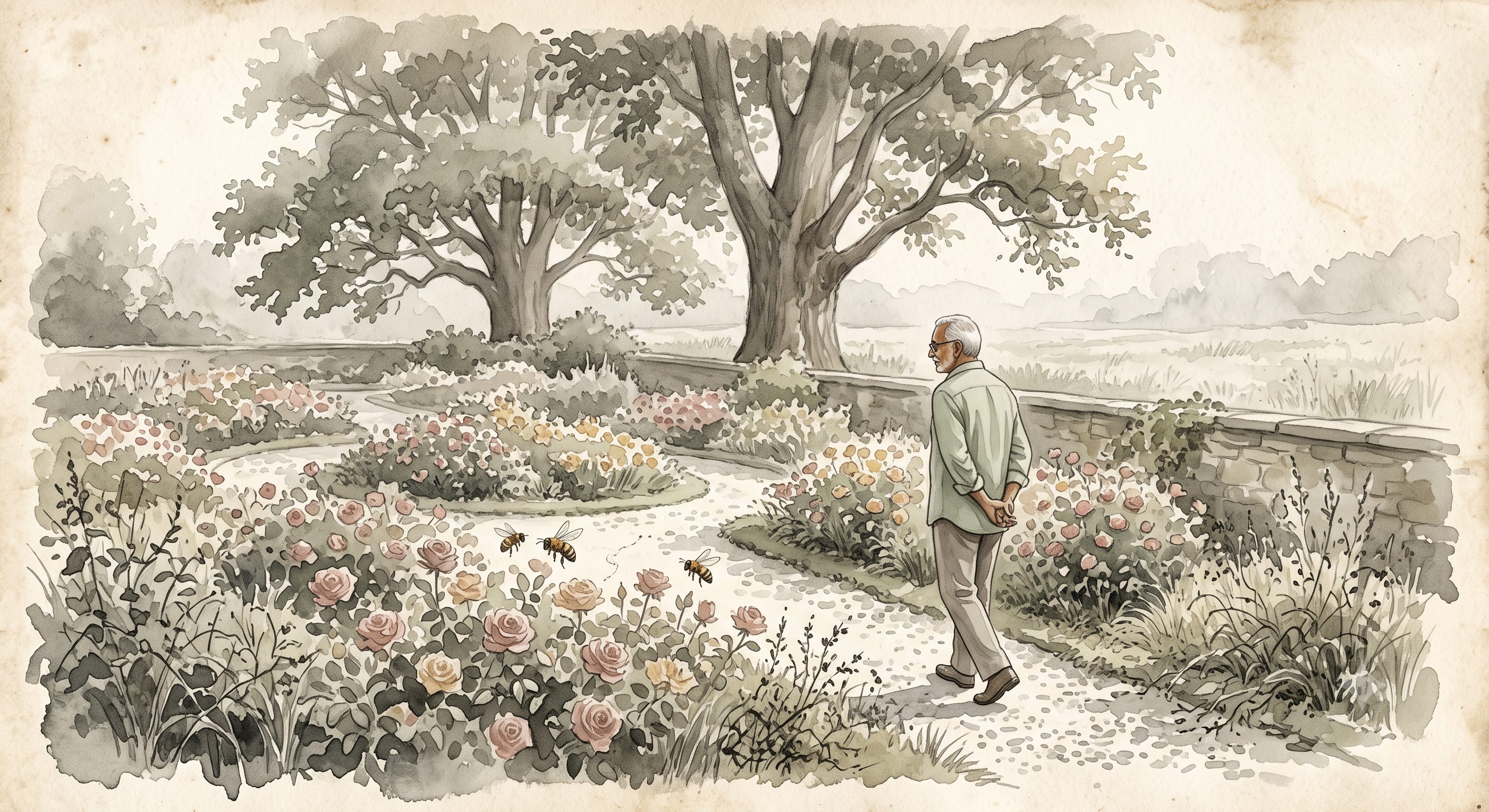
It is an elegant model, clear and grounded in evidence, and yet it has never quite matched the texture of my own experience. Circles are static. Friendships are not. They move with us across workplaces and time zones, across platforms and life stages; they ebb and swell, go dormant and revive. Most importantly, they serve different purposes and survive for different durations. A friendship is a living thing, and a collection of them is not a diagram. I have come to think of mine as a garden: diverse, seasonal, organic, and always changing. And like any garden, it thrives not in spite of its variety but because of it. Every planting serves a purpose that the others cannot.
Walk through the garden with me.
The oldest trees are the friends who have known you longest, the ones who grew up alongside you and have loved you through every version of yourself. You share a school, a dorm, a private language of inside jokes, secrets nobody else will ever hold. Years may pass without a word, and then you reconnect and the conversation resumes from the exact sentence where it stopped, even decades ago. Nobody plants an old tree; you can only have grown up together. Their roots hold the whole garden in place, and they hold you to where you came from and to who you have been.
Near them stand the evergreens, the truth tellers, the friends you call when life turns difficult. They do more than listen. They help you think, recalibrate, regain your balance. You may have found them in childhood or in a corridor at work; one may have begun as a mentor, another as a colleague from a chapter long closed. What marks them is not where they came from but what they carry: your trust, held without condition, in every season. When the rest of the garden goes bare in a hard winter, the evergreens are the ones still standing green. If the old trees keep your past, the evergreens stand with your present.
Then come the annuals, the friendships born of shared setting: the teammate who makes long meetings bearable, the neighbor who becomes a weekend fixture, the parent you stand beside at soccer games. They are the company of now, part of the daily rhythm, and they bloom for exactly one season. When the season ends, when the project closes or the team disbands or the children outgrow the league, most of them go, and this is not a failure; it is what annuals do. I have made warm friendships on boards that lasted ten years, but ended quietly the day I stepped down. But gardeners know that some annuals self-seed. Every so often, one of these friendships comes up again on its own the next year, and the year after, until you look up and realize it has quietly become a perennial. It pays to notice when that happens, so that your expectations match the friendship.
Then there are the flower beds, the friends who make the calendar bright: dinners, concerts, celebrations, the occasional trip taken together. You may never exchange a confidence among them, but you share meals, you share wine, you share joy, and not every friendship must be profound to be precious. Some plantings exist purely for color and fragrance, to make the garden a pleasure to live in, and the garden would be poorer without a single one of them.
Some of the most valuable visitors to the garden are not plantings at all. The connectors are the bees that act as pollinators: they arrive rarely, stay briefly, and leave everything more fruitful than they found it. An author who rearranges your thinking. An introduction that redirects your path. A chance conversation with a wise stranger on a flight. Sociologists call these weak ties, and the research finding is profound and provocative: the weak ties carry the strong consequences. One thing to know about them, though. Unlike bees, these visitors must be invited. The reaching out is your job. They open doors; they do not knock on yours.
Beyond the garden wall lies the meadow: the wide field of digital connection, the followers and contacts who applaud your news with an emoji and vanish. I would not call the meadow a garden. It is plentiful and fragile, awareness without intimacy. But it is not nothing. It is uncultivated potential, acres of it, and once in a while something out there catches your eye. When it does, dig it up and bring it inside the wall. Online is the meadow of promise, but offline is where roots go down.
And then there are the weeds. Every garden has them: the relationships that arrive uninvited, grow faster than anything you planted, and quietly take the water and the light from whatever grows beside them. You know a weed less by its own appearance than by the state of the plantings around it. A gardener does not hate weeds, and does not negotiate with them either. Pulling them is not cruelty. It is what you owe the rest of the garden.
You will notice that family is absent from this garden, and the omission is deliberate. Family is given; friendship is chosen. Spouses are chosen too, of course, and some family members become true friends, just as some friends become family. But this meditation is about the ties we consciously cultivate, the ones defined by choice and reciprocity rather than by inheritance.
Why tend the garden at all? Because time is finite and emotional energy more finite still, and they should go where they matter. Tend the old trees and the evergreens first; they are your core emotional wealth, the people who hold your story. Keep the annuals in bloom while their season lasts, a text, a shared meal, a moment. Welcome the pollinators, who cost little time and pay in horizons. Visit the meadow with open eyes, never mistaking visibility for closeness. And pull the weeds.
A garden is not a lawn. It thrives on diversity and some chaos: the old tree for shade, the rose for fragrance, the hedge for shelter, the annuals for one bright season. You do not ask the tree to flower, and you do not resent the rose for casting no shade. So it is with friends. Our disappointments in friendship come from asking one planting to do another’s work: expecting confidences from a dinner companion, or permanence from a friendship of circumstance. Let each friend be what they are, and the garden as a whole will give you everything.
So it is worth walking your garden every season or so, and asking: which ties deserve watering, and which deserve a gentle pruning? Friendships, like gardens, do not flourish by accident. They thrive when cared for with intention, attention, and gratitude.
What role do 'I' play in the garden?
Am I the gardener, in that I carefully curate, cultivate and prune? This only works if the garden is a concept in my mind, and each plant in it is limited by my perception of it.
Am I another plant in the same garden, in that I take no ownership of what happens to the other plants, stay focused on thriving myself, and yet, contribute to the secret communal life of trees in an ecosystem?
A butterfly perhaps, that flits from one plant to another, enjoying the nectar each plant has to offer, while facilitating cross pollination.. of ideas, of connections, etc?
Mohanbir - A wonderful, thought provoking read. Very much enjoyed it. Thank you. 🤗