


When I graduated from high school in 1978, I joined a few friends on a 10-day trek through the Himalayas in Himachal Pradesh. The days were long, the trails were steep, and the air was thin. What kept us going was the comforting thought of making it to the next camp, with a hot meal and a warm sleeping bag waiting for us. Each time we crested a ridge, we hoped we were almost there. We would ask local villagers coming down the path if we had arrived. Each time the answer was the same, a smile and a shake of the head. Not yet. The place you are looking for is a little further on, just beyond the next hill.
So we climbed the next hill. From the top of it we could see the one after it, and past that another, the path folding upward into the haze with no end in sight. We were climbing a mountain that had no summit.
Today, in my sixties, this memory came back to me as a metaphor. For forty years, I have been climbing the mountain of professional accomplishment. Cresting one achievement after another and asking - have I arrived? A voice inside tells me - “not yet”. There is another accolade, just beyond. The bigger consulting gig. The further recognition. The larger number in my bank account. But there is no summit. Just more hills. I am not climbing. I am on a treadmill.
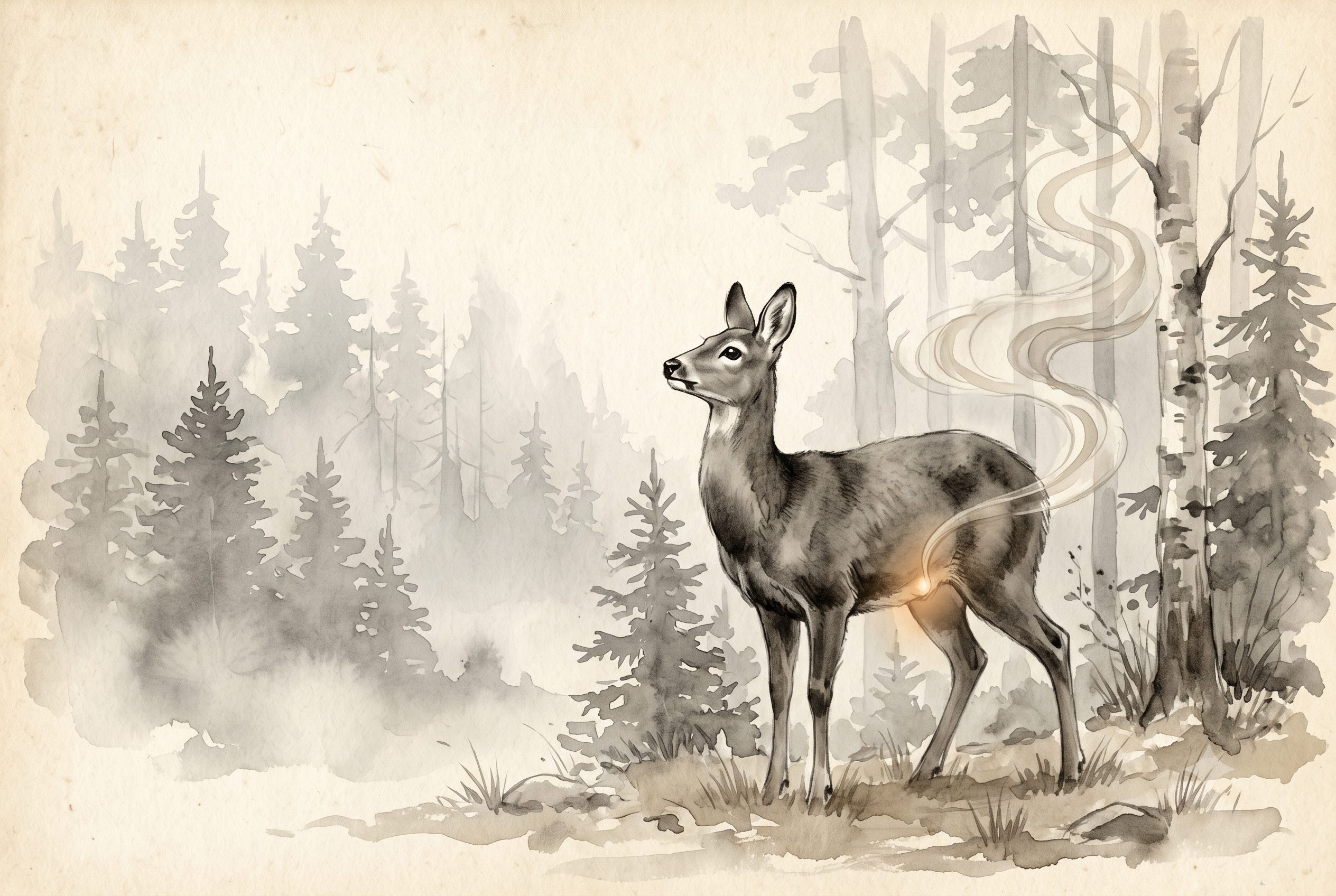
This restless striving reminds me of the parable of the musk deer. The musk deer carries its own perfume in a musk gland. The deer catches the scent, falls in love with it, and searches for the scent. It feels the source must be somewhere just ahead, in the next valley, behind the next tree. It spends its whole life searching for the perfume, never realizing that it has carried the perfume all its life, because it never looks in the one place where the fragrance actually lives.
Kabir, the Sufi saint, turned this image into a profound couplet about the human condition of striving:
Kasturi kundali basai, mrig dhoondhe ban maahi;
Aise ghat ghat Ram hai, duniya dekhe naahi.
The musk is in the deer’s own navel, yet it roams the forest searching. So too the Divine lives in every heart, and the world looks everywhere but there.
We go through life like the musk deer. We catch the scent of something, call it peace, or meaning, or the feeling of having finally arrived, and we are certain it lies out there. On the next rung. In the next deal. Behind the bigger house, the better title, the next million dollars in the bank. So we run, always searching what is outside and ahead, convinced that the answer to the question what comes next is a place we have not yet reached.
But what’s next is not ahead of us. Or outside. To know why we run the way we do, we must understand the seduction of more.
The seduction of “more”
“More” is the most powerful seducer you will ever meet. It is insidious. The seduction comes disguised as ambition, as titles we must gain, as wealth we must accumulate, as recognition we crave. Every step up the mountain is logical, even admirable. No one ever decided, in a single dramatic moment, to spend a whole life chasing a scent that is not there. We decided it one sensible increment at a time.
More keeps its promise. It always delivers the thing. The raise comes, the title comes, the house comes. What it cannot do is make the thing keep mattering. Today’s luxury becomes tomorrow’s baseline almost overnight, and the baseline is no longer enough. It is the trek all over again. You reach a crest, and the summit has quietly moved to the next ridge, a little further on, a little more worth having.
In Hindi we have a name for this, the “circle of the ninety-nine”: the man with ninety-nine coins who can think of nothing but the hundredth, and who, once he has it, can think of nothing but the next ninety nine. We learn to measure ourselves by our net worth until our net worth becomes synonymous with our self worth. We gather the titles and the followers and the likes, and each one thrills us briefly before it sinks into the baseline and leaves us as restless for even more.
The problem of more cannot be cured by more, because the hunger that drives the race is not a hunger of the body, which can be fed, nor of the mind, which can be satisfied. It is a hunger of the soul, and the soul can never be fed from the outside.
The deer is not simply lost. It is caught in a loop that tightens the faster it runs, and from the inside the loop feels like progress.
Riding the ox in search of the ox
The remarkable thing is how many traditions, with no knowledge of one another, arrived at the same insight about material striving.
Zen tells it through its ten ox-herding pictures, which open with a herdsman in a panic, hunting everywhere for his lost ox. He finds tracks, he catches a glimpse, he chases it through the wilderness. The joke of the whole sequence, the thing the seeker grasps last of all, is that the ox was never lost. The Zen masters left us the phrase that says it best: riding the ox in search of the ox. We sit astride the very thing we are scouring the world to find.
The Lotus Sutra tells it through a jewel. A poor man visits a rich friend, drinks too much, falls asleep, and the friend, called suddenly away, sews a priceless gem into the lining of the sleeping man’s robe. The man wakes without knowing about the jewel in the robe and wanders for years in poverty, despite having a fortune stitched into the cloth on his own back. Years later, the two friends cross paths by chance. The wealthy friend is shocked by the man’s severe poverty and says, “How absurd, old fellow! Why have you worn yourself out for basic food and clothing?”. He then reveals the hidden stitches in the robe. The poor man discovers the jewel, sells it, becomes immensely wealthy, and is freed from want forever.
Kabir tells it through the deer. The musk in the navel. The forest searched in vain. The treasure carried, unseen, in every heart.
Three traditions, three idioms, one truth told over and over. What you are searching for, you are already carrying. It was not hidden in the forest, or the next country, or the next decade. It was placed inside you before you ever set out.
The pilgrim and the deer
My own tradition makes the point through the pilgrim, who is only the deer in human clothes. For hundreds of years, Hindu devotees have traveled across the Indian subcontinent to bathe in the holy rivers, visit holy temples, or climb holy mountains. They believe that holy destinations can absolve them of their sins, that their souls can be scrubbed clean by the waters of holy rivers. The Sikh Gurus were not impressed.
Dhotee mool na utrai, je athsath tirath naai.
This filth within is never washed away, though you bathe at all sixty-eight sacred shrines of pilgrimage.
(Guru Amar Das, Sri Guru Granth Sahib, Ang 87)
Sixty-eight holy places. A lifetime of travel. And you arrive home with the same polluted mind and restless heart. Guru Amar Das says it again, plainly:
Man maile sabh kichh maila, tan dhotai man hachha na hoye.
If the mind is unclean, everything is unclean; washing the body does not make the mind pure.
(Guru Amar Das, Sri Guru Granth Sahib, Ang 558)
The pilgrim and the deer are making the same mistake. Both go looking for the sacred somewhere out there, the pilgrim across a continent of holy rivers, the deer across a forest, when it was at home, within, the whole time. The longer and more strenuous the search, the further it carries them from the one place the thing actually lives.
And here the Sikh answer turns radical, and inward. The Gurus did not prescribe holy journeys to faraway lands. They moved the destination. Wherever the Name is remembered, they said, your home and your body becomes all sixty-eight places of pilgrimage at once. The holy place is not somewhere you travel to. It is a quality of attention you can enter at your own kitchen table.
This is why Sikhism never sent its seekers to the cave or the mountaintop. Guru Nanak did not find the divine by abandoning his life. He was a husband, a father, a man who worked and raised a family and stayed in the world. He gave us the figure of the householder saint, the one who is detached while striving, who finds peace not by leaving home but by turning inward in the middle of an ordinary, crowded, working life. The pilgrimage is not a thousand mile physical journey. It is an inner journey, from the outside of yourself to the inside.
The wisdom of enough
So if the answer was never out there, what does it mean to find it in here?
It begins with understanding what “enough” actually is. We treat enough as a number, a figure in an account that we will one day cross, at which point the wanting will finally stop and the peace will switch on. That number does not exist. It never has. For a simple reason. Enough is not a quantity. It is a relationship to what you already have.
Enough is not a quantity. It is a relationship to what you already have.
A person can have very little and be content. A person can have nearly everything and feel poor. The difference is not in the holdings; it is in the gaze. This is the wisdom the Gurus called Santokh, contentment. Santokh is not renunciation. It is not the death of ambition. It is the death of the anxiety that drives it. You can still build, still strive, still reach, but your peace is no longer held hostage by the result. You can say, honestly, I would like more, and I am not empty without it, and I am not defined by it.
The seduction of more makes you feel you are incomplete until the next thing arrives. Enough is the discovery that you were complete already, that the fragrance was there all along. Guru Amar Das put the whole of it into a single line.
Man tu jot saroop hai, apna mool pachhan.
O my mind, you are the embodiment of the Divine Light. Know your own source.
(Guru Amar Das, Sri Guru Granth Sahib, Ang 441)
It does not tell us to become light through enough striving. It tells us we already are light. All we have to do is to recognize the light within us. The image the Gurus loved is the lotus, which grows out of the swamp, draws its nourishment from the swamp, and is never sullied by it, rising clean above the very mud that feeds it.
So strive with everything you have. But hold the striving lightly. Let ambition be your fuel, but don’t get burned by the fire. That is true ascent. Not running farther up a mountain that has no top, but turning around, and walking home.
How the deer stops running
The turn inward is not withdrawal. It is quite the opposite. It is a daily and strenuous practice that is harder than any climb, because nearly everything around us is built to keep us facing the wrong way.
It begins with the simplest thing a busy person can do, and the hardest, which is to stop. To pause before the hand reaches for the phone in the morning. To put a single breath between the urge and the action. The deer cannot smell what rises from its own body while it is sprinting; that scent is faint, and it comes only in stillness. So we must make room for stillness. A few minutes of meditation, of Simran, of sitting quietly with the breath, and the mind begins to settle and a small clearing opens in the forest. Gratitude is another valuable practice. Be thankful for all that you already have before reaching for more: your health, your wealth, your loved ones, and indeed, the sheer fact of being alive against the odds. So does service, because it loosens the grip of the grasping self, and in that loosening we find that possessions never mattered as much as we thought.
Stillness. Gratitude. Service. These are the methods to slow down the deer, to find the ox, and to arrive at the holy site that is within us.
What comes next
I come back to where I began, to the question that we ask so often in life: What comes next.
We treat it as a question about the future, the next role, the next move, the next acquisition, and so we scan the horizon the way the deer scans the forest, believing that the answer is out there, just ahead. But the deer was wrong about the forest, and the pilgrim was wrong about the rivers, and we are wrong about the horizon. What comes next was never a place further down the road. The road has no end, and arriving was never waiting at the end of it.
What comes next is not ahead of you. It is inside you. It always was.
The fragrance you have spent a lifetime chasing is not hidden somewhere in the forest. It is rising, right now, from somewhere very close. Closer than the next hill. Closer than your own breath.
You do not need to run anymore.
You need to stop, and grow still, and catch at last the scent of what you have carried all along.
Loved reading this. And reminded of a Ghalib sher that does the same beautiful “turn inwards” thing.
Umr bhar Ghalib yahī bhūl kartā rahā
Dhūl chehre par thī aur āīna sāaf kartā rahā
Absolutely beautiful, thank you for this