


I am a teacher and a speaker. Sometimes, I give the same talk dozens of times. The slides are familiar. The structure is rehearsed. The jokes have been road-tested in boardrooms and classrooms.
You might think that this kind of repetition would dull the experience. That I would get bored, go on autopilot, phone it in. That the audience would sense that I am merely going through the motions, delivering material the way a vending machine dispenses cans.
This never happens, because I never allow myself to forget an asymmetry. For me, it may be the hundredth time. For the person in the third row, it is the first and possibly the only time. That asymmetry changes everything about how I show up.
Repetition is not the enemy of a great performance. It is the precondition for one.
Experiential Asymmetry and Quiet Responsibility
A performer and the audience occupy the same room, but they inhabit completely different realities. One has seen the movie a hundred times. The other is watching it in wonder for the first time. I think of this as experiential asymmetry, and once you see it, you cannot unsee it. This asymmetry carries a quiet but serious responsibility. My hundredth delivery must feel, to the listener, like it was crafted just for them. Not because I am pretending, but because I have done the deeper work of staying genuinely present inside familiar territory.
Here is what I do. I keep the skeleton of the talk intact - the core arguments, the logical arc, the key frameworks. But I bring new flesh and blood to the narrative each time. I swap stories. I change metaphors. I adjust the voiceover while keeping the same slides underneath. I read the room and shift tone, pace, and emphasis based on what I sense.
Most importantly, I try to enter what musicians call the zone. Mihály Csíkszentmihályi called this state “flow”: the point where skill meets challenge and self-consciousness falls away. For me, it means drawing on something childlike in myself, a genuine curiosity about the ideas, as though I am discovering them alongside the audience rather than delivering practiced conclusions. This is not an act. It is a practice. And it produces something that feels alive rather than replayed.
The paradox is worth pausing on. Because I am not worried about what to say, I can pour all my attention into how it lands. Mastery of the content frees me to be present with the people. The preparation disappears into the performance, the way a jazz musician’s thousands of hours of practice disappear into an improvised solo.
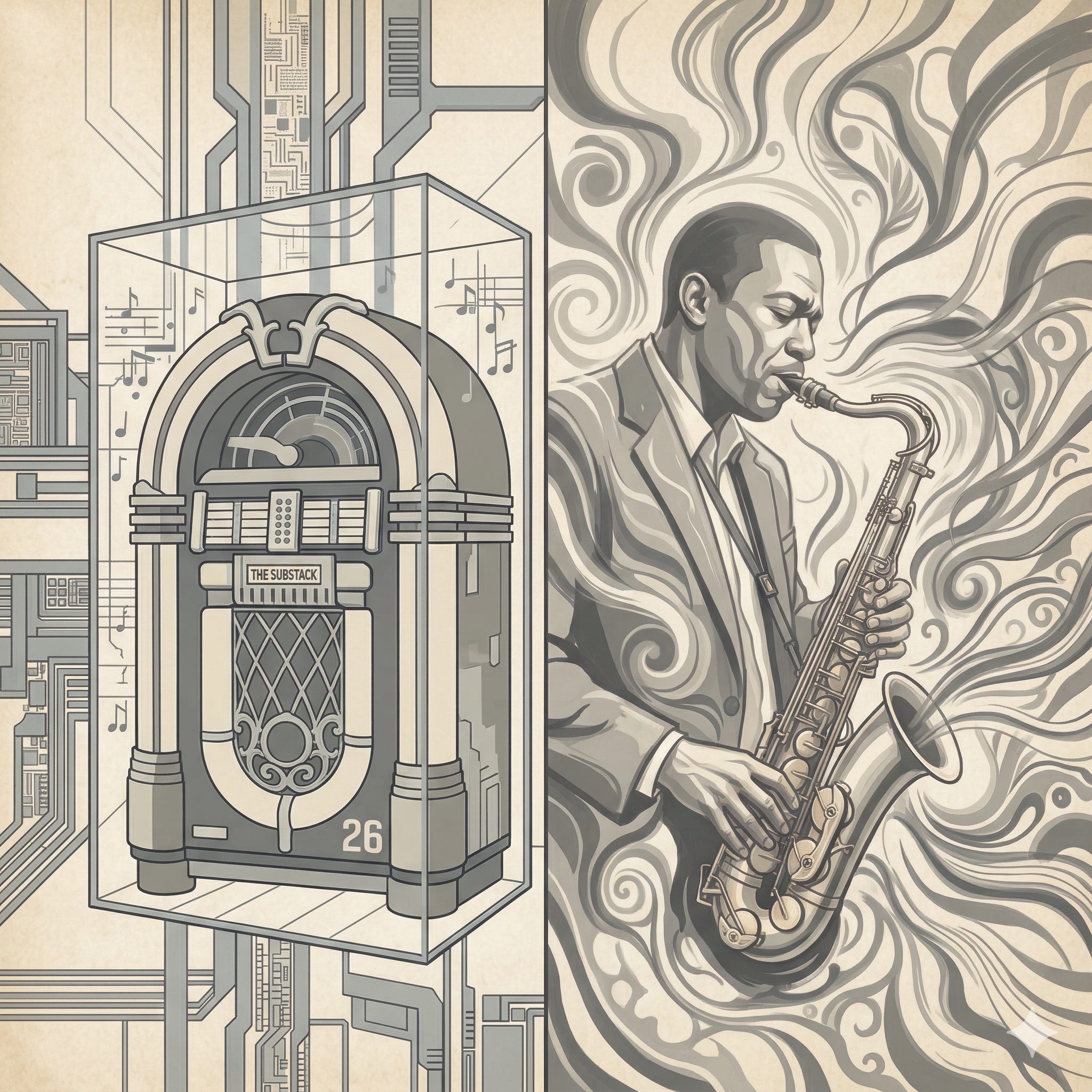
Which brings me to the metaphor at the heart of this piece.
Jukebox vs. Jazz
A jukebox plays the same song the same way every time. Perfectly reproduced. Perfectly indifferent. There is no room for the moment, no awareness of who is listening, no variation in feeling or emphasis. It is reliable, but it has no creativity.
Jazz plays within a structure but responds to what is happening in the room. It breathes. It listens. It wanders and riffs and circles back to the theme. The melody is recognizable, but the performance is unique every time because it belongs to this audience, this evening, this particular collision of energy and attention.
This is the distinction that separates competence from artistry in any domain that involves repetition.
The Discipline of Wonder
Consider Taylor Swift on the Eras Tour. Over nearly two years, she performed 149 shows across 51 cities and five continents. Each show ran over three hours and featured more than 44 songs choreographed into ten distinct acts. The production was engineered down to the minute. The songs were, by definition, the same night after night.
For the Swifties in the crowd, none of that mattered. Each concert was a once-in-a-lifetime event. Months of anticipation. Friendship bracelets traded like sacred tokens. Emotional peaks that would be replayed for years. Over ten million fans bought tickets, many traveling hundreds of miles to be there. No one in that stadium experienced the show as routine.
For Taylor Swift, it was also work. Physically demanding, emotionally exhausting, rigorously professional work. She cancelled only two shows across the entire run. And yet no serious observer would say she was going through the motions. What made the difference was not novelty. It was interpretation. She performed different surprise songs at every single show, drawing from a pool of 145 tracks across her discography. She adjusted lyrics to mark the moment. She read the crowd and responded to signs in the audience. She created small, spontaneous gestures that made each night feel like it belonged only to the people in that arena.
She played jukebox material with a jazz sensibility. And that is why the Eras Tour became something closer to a cultural pilgrimage than a concert series, grossing over two billion dollars and becoming the highest-earning tour in the history of live music.
Experiential Asymmetry Is Everywhere
Once you develop eyes for this pattern, you find it across every industry and role where one person’s routine is another person’s milestone.
A Disney cast member greeting a child who has counted down the days for months. A tour guide explaining a cathedral for the thousandth time to someone seeing it for the first. A nurse delivering test results that are, for her, a Tuesday afternoon briefing and, for the patient, a life-altering moment. A TSA agent repeating the same instruction hundreds of times a day to travelers who are anxious, disoriented, or simply having a terrible morning.
In every case, the interaction is deeply asymmetric. For one party, it is routine. For the other, it is anything but. And the professional who recognizes this asymmetry, who refuses to let their own familiarity flatten someone else’s experience, is the one who turns a transaction into a connection.
Professional excellence is not about pretending every moment is magical. It is about recognizing that someone else’s wonder often lives inside your routine and choosing to honor it.
A Practice, Not a Performance
I want to resist turning this into a tidy five-step framework, because the heart of the idea is more like a discipline than a technique. But there are practices that help, and they are worth naming.
Master the structure so it disappears. Know your material well enough that it no longer consumes your attention. Expertise is not about showing off how much you know. It is about freeing yourself to be human in the moment. A jazz musician who is still thinking about chord changes cannot listen to the room.
Vary the expression, not the essence. Change the stories, the metaphors, the examples, the pacing. Variation keeps you engaged with your own material, and engagement is contagious. Audiences do not catch your ideas. They catch your energy.
Play for the room you are in. Every audience has a rhythm. Some rooms are skeptical and need to be won over slowly. Some are eager and want you to match their pace. Energy is not volume. It is the ability to listen while you speak.
Perform for one. Before you begin, imagine one person in the audience for whom this moment truly matters. Perhaps it is the young professional who will rethink their career because of something you say. Perhaps it is the student in the back row who almost did not come today. That person becomes your anchor. You play for them.
Protect presence, not enthusiasm. You do not need to be “on” every second. You need to be genuinely present at the moments that count. One authentic pause, one honest aside, one real connection can outweigh ten minutes of polished delivery. Presence is not a performance. It is a choice to show up fully, even when the content is familiar.
The Musician’s Return
There is a concept in Indian classical music called riyaz, the daily practice through which a musician internalizes ragas so completely that performance becomes an act of expression rather than execution. The notes are known. The structure is given. But within that structure, the musician finds freedom, because mastery has made the scaffolding invisible.
I think about riyaz every time I step onto a stage. I know the slides. I know the arc. I know where the laughter tends to come and where the silence deepens. The audience does not. And that difference is not a burden. It is a gift. Because it means I get to watch someone encounter an idea for the first time, and if I have done my job, I get to feel the electricity of that encounter as though it were my first time too.
So I show up as a musician, not a machine. I play the same tune, but I listen for new notes. I wander, I riff, and I return to the theme. And in doing so, I rediscover why I love this work.
Because for someone in the room, this is not repetition.
It is a moment.
And moments deserve jazz.
A situation where I was struggling in.
Thanks to this article , I feel new blood flow all throughout my veins
Great insights, Mohan. I shared it with a blues/jazz musician I know who made the following comment:
"Interesting point of view with the jazz analogy but his main premise about jazz musicians playing and responding to what's happening in the room overlooks more important points of the jazz musician's perspective, goals and raison d' etre.
Although it can be highly inspiring to play a great room with an enthusiastic audience, jazz musicians are highly introspective and often (and most importantly) play/improvise for themselves and the musicians they are performing with.
Playing the room is important but performing/improvising for their own self-critical, artistic souls is a higher priority.
Miles Davis sometimes even played with his back to the audience. Watch a jazz show and you rarely see musicians focused on the audience/room.
Eyes are often closed, heads are down in concentration and mostly focused on the music and improvisation they're creating onstage.