


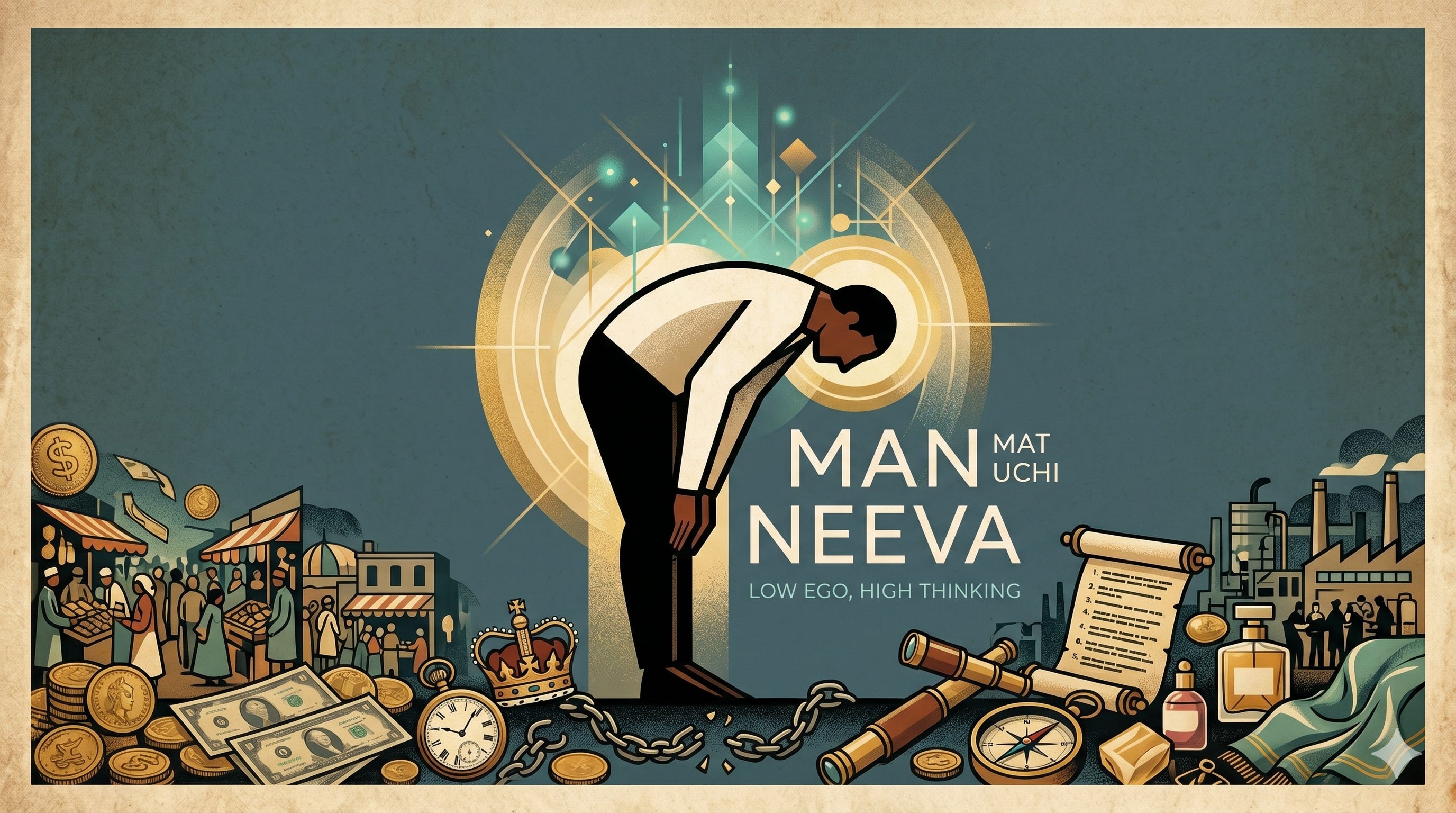
Man neeva, mat uchi. Sikhs recite these four words during the Ardas, the concluding act of every prayer service. I have said these words aloud thousands of times. For most of my life I treated them as a beautiful piece of liturgy, a small request slipped in near the end of the prayer that you made with closed eyes and quickly moved past. But when you get older, you become reflective. When I read these words with the attention they deserve, I saw the deep wisdom of the ask from the Guru, and how startlingly modern the request is, once you dive deeper into the meaning.
Let me translate the words carefully, because casual English translations lose the nuances of the phrase. Man is the inner organ that carries ego, desire, and identity, the seat of the self that says I. Neeva means low, lowered, bowed, brought close to the ground. The word mat points to the faculty of discernment, the part of a human being that perceives clearly and chooses well. Uchi is high, lifted, elevated. The Sikh’s daily petition asks us to structurally rearrange our interior: the ego-self must be lowered while the discriminating intelligence must be raised.
Contrast this phrase against the world we live in. The modern world rewards ego, every day, in every walk of life. We train young people to lift the I, to project the self, to invest in self-confidence on the assumption that competence will follow. The corporate world and the political world are dominated by outsize egos, from Elon Musk and Bill Gates to Donald Trump and Kamala Harris. The result – executives who fill a room with more presence than perception, who speak first in every meeting and learn little from the people around them.
The Guru’s instruction runs the other way. We are told to lower our self so that our discernment can rise. The leader who stops defending the I can listen with empathy rather than with rebuttal. Lowering the self is what makes empathetic listening structurally possible. The reason is simple. When the leader’s ego fills up the room, it leaves little room for others to be heard or respected.
This essay offers a single proposition. Bowing, properly understood, is the highest posture any of us can take, and the lowering of the self is what creates the elevation of every faculty worth elevating. To anyone working inside the modern leadership academy, the proposition has a familiar ring, By the end of this essay I will show my institution has enshrined a core value that our Gurus revealed five hundred years ago, and that the empirical research on what separates great leaders from merely competent ones has been making the same case across the past fifty years of management scholarship. But the rediscovery is the easy part.
The harder part, and the one this essay takes first, is the verse that explains the mechanics, and that verse sits on Ang 466 of the Sri Guru Granth Sahib, in the seventh pauri of Asa di Var. It is a paradoxical verse:
Haumai deeragh rog hai, daaru bhi is mahen.
Ego is a long disease, and the medicine for it lives within the disease itself.
Read the line slowly and pause. The Guru has packed three teachings into eight words, and a casual reader will completely miss the layers of insight that lie beneath the surface of these words.
The Disease, Named
The surface teaching of the verse is the diagnosis. The word deeragh is derived from Sanskrit. It means long, chronic, sedimentary, a condition that persists for a lifetime and accompanies a person to the grave, shaping every decision in between. The Guru is being honest about what kind of medicine the prayer will provide. The cure is real, but it is slow.
The pauri that culminates in this verse opens with an inventory that sounds like a coroner’s report on the unawakened life. In ego we are born; in ego we die. In ego we earn and in ego we lose. In ego the questions of sin and virtue are framed; in ego we laugh and weep and calculate and accumulate and forget. The small word vich, meaning inside, is chosen deliberately. Ego is the medium in which the unawakened life is conducted from first breath to last, the water in which the fish unwittingly swims.
Sikh scripture is uncompromising about ego. The Gurus did not place ego as one item on a list of moral failings, alongside greed and anger and lust, to be confessed periodically and corrected in due course. They placed ego (Haumai) at the root and treated every other failing as a branch growing from it. The Gurus see Haumai as the soil from which every weed of vice grows, and the only effective intervention is therefore an intervention on the soil itself.
Kabir, the Prosecutor
The Gurus diagnose with the care of physicians. Bhagat Kabir, whose verses sit alongside theirs in the Sri Guru Granth Sahib, says the same thing plainly. He is a weaver, and he is refreshingly blunt. On Ang 1366, in three consecutive saloks numbered thirty-eight, thirty-nine, and forty, Kabir delivers an unsparing teaching on ego.
The first salok takes aim at ego arising from material possessions. Kabir garab na keejiye, ucha dekh avaas; aaj kaalh bhuye letna, oopar jaamai ghaas. Do not be proud, Kabir says, of your tall mansions. Today or tomorrow, you will lie beneath the ground, and the grass will grow above you. The image is stark. It skips the moral lecture and goes straight to the point that your possessions will desert you when you leave the world.
Kabir turns next to social standing, and to the human instinct to look down at those who have less. Kabir garab na keejiye, rank na hasiye koi; ajhoo so naao samundar mein, kya jaano kya hoi. Do not be proud, he warns, and do not laugh at the poor man, because your own boat is still at sea, and no you do not know what may happen to it. The joke may be on you, and you don’t even know it!
The third salok addresses the last refuge of vanity, the physical body itself. Kabir garab na keejiye, dehi dekh surang; aaj kaalh taj jaahuge, jio kaanchuri bhuyang. Do not be proud of your beautiful body. Today or tomorrow, you will leave it, the way a snake leaves its skin. The snake does not mourn its skin, and the body will not mourn the I that once lived in it.
Read the three saloks together and the architecture comes into view. Kabir identifies the three pillars on which ego has rested since times immemorial: property, position, and physical body. He dismantles them one by one. The reader who reaches the end of salok forty has nothing left to be proud of, which is exactly the position the Guru was hoping to find him in.
The Five Evils Are Children of Ego, Not Siblings
This brings us to an important doctrinal point. The panj doot, the five messengers (or Five Thieves) of lust, anger, greed, attachment, and pride, are commonly read as the Sikh equivalent of the Christian deadly sins, five independent vices to be subdued one at a time. The Gurus arranged the matter differently. The Five Messengers are best understood as the children of Haumai rather than as siblings of equal standing, each one drawing its strength from the parent rather than from itself.
A careful reader of Gurbani will object at this point. Ahankar, after all, is the Punjabi word for pride, and pride is itself one of the Five. If ahankar is already a kind of ego, how can it be a child of Haumai rather than the parent itself?
The objection rests on a translation gap that the English renderings tend to flatten. Haumai and ahankar are not synonyms. They sit at different rungs of the same ladder. Haumai is the prior ontological condition of identifying with the I in the first place, the soul-level misreading of the self as a separate, persistent agent, and the compound fuses hau, the subject pronoun, with mai, the object pronoun, naming the grammatical error of self-reference at its very root. Ahankar comes from aham, also meaning I, and kar, the verb of doing or making. The compound means literally I-making, the active manufacture of self-importance, the social act of asserting one’s own primacy against others. Haumai can be suffered in silence, alone in a room, with no one to be proud in front of. Ahankar requires an audience, even an imagined one.
This makes the parent-child relationship mechanically clear. Without haumai there is no separate I to assert, and without an asserted separate I there can be no ahankar. The reverse does not hold. A person can be deep in haumai without ever displaying visible pride, and the outwardly modest individual who is internally suffused with his own primacy is in haumai up to his neck while showing no ahankar at all. This is the more dangerous case, because the disease has hidden itself from the patient who carries it. Dangerously infected, but asymptomatic!
The architecture of parent and child changes the entire approach to the moral life. If lust and anger and greed are five independent enemies, the practitioner becomes a moral firefighter, racing from blaze to blaze, exhausted before he reaches the fifth. If, on the other hand, all five blazes are fed by a single underground gas line called Haumai, you can find the valve, cap the source, and the fires go out on their own.
This is why the Sikh prescription is a single positive practice rather than a long list of negative commandments. Naam Simran, the remembrance of the Divine Name, displaces the ego instead of trying to extract it surgically. The mind cannot remember the Divine and itself in the same breath, and in the duration of the remembrance, the I loses its grip. Done daily over many years, the displacement becomes a habit, and the habit eventually becomes the new architecture of the self.
The Cryptic Cure Within the Disease
We can now return to the verse on Ang 466 and read it with the depth it deserves. Haumai deeragh rog hai, daaru bhi is mahen.
The most immediate of these concerns where the medicine is located. The cure for ego does not lie in some external act of austerity, in the renunciation of family or trade. Sikh thought has been unsentimental about this from the founding. The householder’s life is the spiritual life, the workplace is the dojo, and the Guru pointed inward, to the very condition we were trying to escape.
The deeper teaching concerns what haumai really is. Beneath any obvious arrogance lies the more basic claim I am the independent doer, the soul-level conviction that one’s actions, possessions, and achievements are owned outright by an autonomous I. The cure repositions the I rather than removing it, moving the self from the center of its own little universe to its proper place inside the larger order of Hukam. The same self that once says I achieved this learns, over many years of practice, to say I was allowed to participate. The I-ness remains intact while the mine-ness gradually loosens its grip.
This is also why the cure is so difficult to take. The ego wants to manage its own disappearance while remaining in charge of the process, and an honest practitioner knows the moment when one realizes that one has been performing humility, and the performance itself is haumai in its most refined form. For instance, most charitable giving suffers from this problem because the giver is attached to ego and the giving is attached to an expectation of a reward in this life or the next! The verse anticipates this by placing the cure beyond the reach of ego-driven self-improvement, in the awakened awareness of how thoroughly the I has rigged the game.
The line that immediately follows on Ang 466 supplies the activating mechanism: kirpa kare je apni, ta gur ka shabad kamahe. If the Lord grants His grace, then one earns the Guru’s Shabad. The verb kamahe (earning) is crucial. Kamahe does not stop at reading the Shabad or understanding it; it asks for the Shabad to be lived, embodied, earned through the daily conduct of an actual life, and the earning begins only after grace has opened the door. The Guru gives us a powerful insight: effort without Divine grace is futile, and grace without effort is wasted.
Effort without Divine grace is futile, and grace without effort is wasted.
I return to this verse whenever I notice someone, including myself, defending an ego position that is costing him more than it could be worth. The disease is real and chronic; the medicine sits within reach; and the medicine becomes active only when you stop pretending the disease is not there.
Man Neeva, Mat Uchi, in the Body
The morning prayer can now be read with the precision it deserves. Man neeva, mat uchi is the operational form of the cure Guru Nanak diagnosed on Ang 466, what the cure looks like when it descends from doctrine into the body. The Sikh is asked, every morning before the day begins, to take the daily dose.
The full Ardas line is worth reflecting on: Sikhan da man neeva, mat uchi, mat da rakha aap Waheguru. May the Sikhs’ mind remain humble, their wisdom elevated, and may Waheguru himself remain the guardian of that wisdom. The third clause is important, without which the prayer would not hold. Even elevated mat can be captured by the ego, which is exquisitely capable of becoming proud even of its own humility and wisdom. The Sikh therefore asks for two things in the same breath: low ego paired with high discernment, and the discernment itself shielded from the ego that would otherwise claim it.
It matters what man neeva does not mean. It is not a license for weakness, timidity, or self-erasure. Sikhi honors courage, sovereignty, and the saint-soldier ideal, and the tradition that prays for the humble mind is the same tradition that asks for sword in the hand. A low mind is grounded rather than defeated, free of the inflation that turns every encounter into a referendum on the self. The Sikh sense of humility is best understood as right-sizing: a self that has stopped being the measure of everything in the room. Mat uchi, similarly, is not high IQ or cleverness; the proud mind frequently has both. Mat is moral and spiritual discernment, the capacity to see clearly when self-interest and self-image have been removed. Humility opens the doors of perception that pride keeps closed. The Guru’s instruction is therefore also an epistemological one: the lowered mind sees more, because it has stopped trying to occupy the center of the picture.
Guru Nanak gives the same teaching a sweeter form on Ang 470: Mithat neevi Nanaka, gun changiaian tat. Sweetness and lowness, O Nanak, are the essence of all virtues and goodness. Humility is the soil. Without it, courage curdles into recklessness; generosity slides into condescension; even devotion becomes one more performance of the I. On the same Ang, the Guru places the simmal tree on an imagined scale: the silk-cotton stands tall and wide, but its flowers carry no nectar, its fruit has no taste, and its leaves bring no shade. Niveh su gaura hoi. What bows is what is heavy. Spiritual gravity is measured by depth of bow.
Guru Arjan, the fifth Guru, compresses the entire teaching into a couplet on Ang 278. Sukhi basai maskeenia, aap nivaar tale; badde badde ahankaria, Nanak garab gale. The humble live in peace, having dissolved the self; the proud and self-important, O Nanak, are themselves dissolved by their pride. The verb gale is brutal in the Punjabi, meaning melted away. After three decades of advising leaders, I have come to read this couplet as an empirical observation rather than as a moral warning. Pride does not get punished by some external agency. It dissolves the structure it pretended to support.
The Modern Rediscovery
The Sikh insight is five hundred years old. Its empirical confirmation by the modern leadership academy is recent, and to my eye slightly funny in the way that all rediscoveries are funny. The tradition that has been praying man neeva, mat uchi every morning since the sixteenth century has internalized something that the West has had to assemble through case studies and regression analyses and book tours.
The first piece of the assembly came in 1970, when a former AT&T executive named Robert Greenleaf published an essay called The Servant as Leader. Greenleaf’s claim was that real leaders serve rather than ask to be served, and his diagnostic test was elegant. Look at the people who report to you, he said, and ask whether they are growing, becoming more autonomous, becoming more capable. If the answer is yes, you have built leverage. If the answer is no, you have built dependency, and dependency does not scale, because it consumes the very leader who created it.
The second contribution arrived three decades later, when the management researcher Jim Collins and his team studied more than fourteen hundred companies in search of the variable that separated the businesses that made the leap to sustained excellence from those that did not. The variable turned out to be a particular kind of executive, whom Collins called the Level 5 leader. He defined the type in a sentence that any reader of Gurbani will recognize at first sight. Level 5 leaders blend, Collins wrote, a paradoxical combination of “deep personal humility with intense professional will”. The phrase is the morning prayer of the Sikh in Harvard Business School translation.
Collins thought he was describing a paradox, but the Sikh tradition sees no paradox at all. There is no real tension between humility and will, because the energy a proud person spends defending the I is precisely the energy that the humble person has free for the work. The arithmetic is unforgiving. A human nervous system runs on a fixed budget of attention, and ego is the most expensive process that system can host. Lower the man, and the resources become available; the mat and the will both rise on the savings. What Collins observed and labelled a paradox, the Guru had already articulated as engineering.
Which brings me to the institution I have served as a professor for more than three decades. Kellogg School of Management articulates its leadership standard in four words that appear in the alumni magazine, on the official programs page, and in every conversation about what it means to be a Kellogg graduate. Kellogg Leaders, the school says, are high-impact and low-ego. The phrase has become so embedded in the culture that an Executive MBA cohort recently founded a pitch competition called LEHI, an acronym for Low Ego High Impact, treating the principle as a selection criterion for serious entrepreneurial work.
Here is the convergence that I want to leave with the reader. Every morning across the Sikh diaspora, devotees petition the Almighty with a phrase that fits on a coin: man neeva, mat uchi. Every autumn in Evanston, Illinois, Kellogg welcomes a new MBA class with a phrase that fits on a coffee mug: low ego, high impact. The two formulations were created hundreds of years apart, by traditions that had no knowledge of each other. Yet they are almost the same words, in the same order! The Guru articulated as a daily prayer what one of the world’s leading business schools now articulates as a core value. Between the two formulations sits Jim Collins’s research, offering empirical confirmation that the leaders who built lasting greatness were, almost without exception, people whose ego was low and whose will was high.
The Posture We Must Remember
The Guru is asking for something subtler than self-improvement. He is asking for daily remembrance. Humility was the design of the human interior all along, and the work of a Sikh life is to stop resisting that design rather than to manufacture humility from scratch. Haumai is a long disease, but the verse on Ang 466 insists that the condition is built into human consciousness on purpose, for reasons we will never fully understand, and that the medicine, mercifully, was built in alongside the disease.
When the Kellogg leader walks into a meeting and chooses the better question over the impressive answer, she is taking the daily dose. The dose may also be taken silently, by allowing a junior colleague to be right in a room where she could have been right more loudly, or by resisting the small instinct to defend a position simply because the position carries her name. She has never read Asa di Var. But the prayer is working its magic through her anyway.
The grass, as Kabir reminds us, will grow above all of us in due course. The only question that matters at the end of our lives is what we did with the time we had, and from what posture did we do it. The Sikh tradition answers this question definitively, and the message is reinforced daily by the Ardas. The bow, properly practiced, is the highest posture any of us can take.
Man neeva, mat uchi.
I love your articles! This one is just superb. Man neeva, mat uchi will stay with me for a long time.
Thank you so much for writing this.