


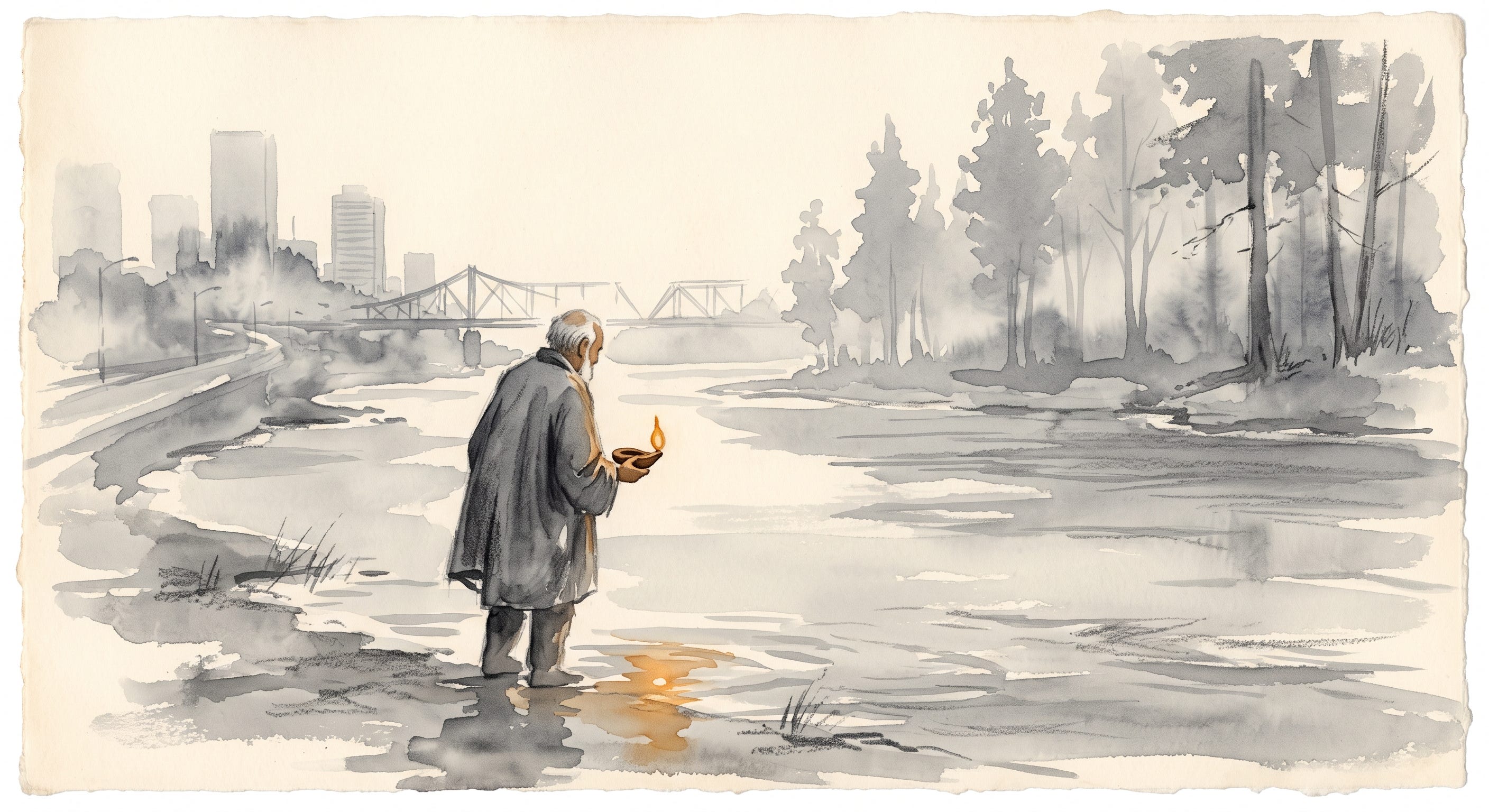
I meet many retired executives. Inevitably, they introduce themselves with a sentence that begins with the word former: former senior executive of a company, former partner at a consulting firm, former owner of a business. The word is a tether. The job has ended, but they are still defined by it. The horseless carriage and the wireless phone carried the same kind of tether, until they became the automobile and the mobile phone.
The tether is a symptom of a crossing that is half-made. Leaving a corporate career involves two crossings. The outer crossing is the passage out of the role: the title given up, the calendar emptied, the successor installed. The inner crossing is the passage from a life organized around what you build and what you hold to a life organized around who you want to become. The first faces backward, toward your professional record. The second faces forward, toward the thirty years that remain. A retirement date completes the outer crossing. It does nothing for the inner crossing.
I turn sixty-three this month. I have no plans to retire. I still teach, write, and advise. Outwardly, my professional life has not changed. But I stand at the same threshold as the executives I describe. Like my peers, I read a lot of advice about what to do in the post-retirement life. Protect your health, because strength and fitness at sixty buy years of function at eighty. Get your finances and estate plans in order. Build a portfolio of activities, usually some combination of board seats, consulting, and teaching. It is all good advice, and I agree with it. But it is incomplete.
Boards, consulting, philanthropy and teaching are professional work configured differently. They change the outer shape of a life by moving LEGO blocks around. They do very little to change the person living it. The outward advice says nothing about the inner journey that has to accompany the passage into post-retirement life. This essay is about the other half of the passage: the inner crossing. A retirement date completes the outer crossing. The inner crossing has no fixed schedule and no obvious destination, which makes it all the more important to decide who you want to become and to walk toward that destination deliberately.
An Old Map for a New Threshold
The Hindu tradition described this threshold more than two thousand years ago. Its four ashramas divided a life into the stage of the student (brahmacharya), the householder (grihastha), the forest dweller (vanaprastha), and the renunciant (sannyasa). I adapted this framework to fit the arc of a modern career: the learner or shishya, the doer or kartā, the giver or dātā, and the awakened or bodhi. An executive leaving the corporate world stands where the householder once stood when it was time to set out for the forest. Vanaprastha means, literally, one who has set out for the forest.
The Manusmriti describes that moment with precision. The householder should go “when he sees his skin wrinkled, and his hair white, and the sons of his sons” (6.2). The signal for the crossing lies in the body and the family. There is no fixed age or date. He may entrust his wife to his sons or take her with him (6.3). He gives up his belongings and the food of cultivated fields, and he carries his sacred fires into the forest (6.3 and 6.4). And the text sums up his conduct there in a phrase that could serve as a job description for everything that follows a corporate career: he should be “ever liberal and never a receiver of gifts” (6.8).
The ancient forest dweller made both crossings at once. He simplified his outer life and deepened his inner one in the same act of leaving. The modern executive tends to make only the outer one.
Two Crossings, Two Clocks
The outer crossing runs on the calendar. It has a farewell dinner, a succession plan, and a long list of advisers: financial planners, lawyers, board search firms, personal trainers, and coaches. It is visible to everyone, and it is completed on a specific date.
The inner crossing has no date and no advisers. It begins when you are freed from the questions that held you captive during your career: what can I achieve, how high can I rise, how much can I earn. When your career ends, other questions take their place: what you can give, whom you can help to grow, and who you are without the role.
Many executives never finish the inner crossing. The symptom of a half-made inner crossing is the distress that retirement so often creates: the loss of identity, the missing structure, and the fear of becoming irrelevant. It is the condition of a person who has left the corporate career on paper and is still living inside it.
Exhibit 1 draws the two journeys across the arc of a person’s life. The outer journey, which is the growth of roles, reach, and possessions, rises through the learning and doing years and narrows after sixty whether we plan for it or not. The inner journey, which is the growth of self-knowledge, detachment, and generosity, builds slowly through the early decades and must become the stronger current in the second half of life. The crossing is the stretch of years in which the two lines meet. The dashed line shows the inner journey left untended, which is where a plan built only around health, money, and a portfolio of roles will lead.
Exhibit 1. Two Journeys and Two Crossings
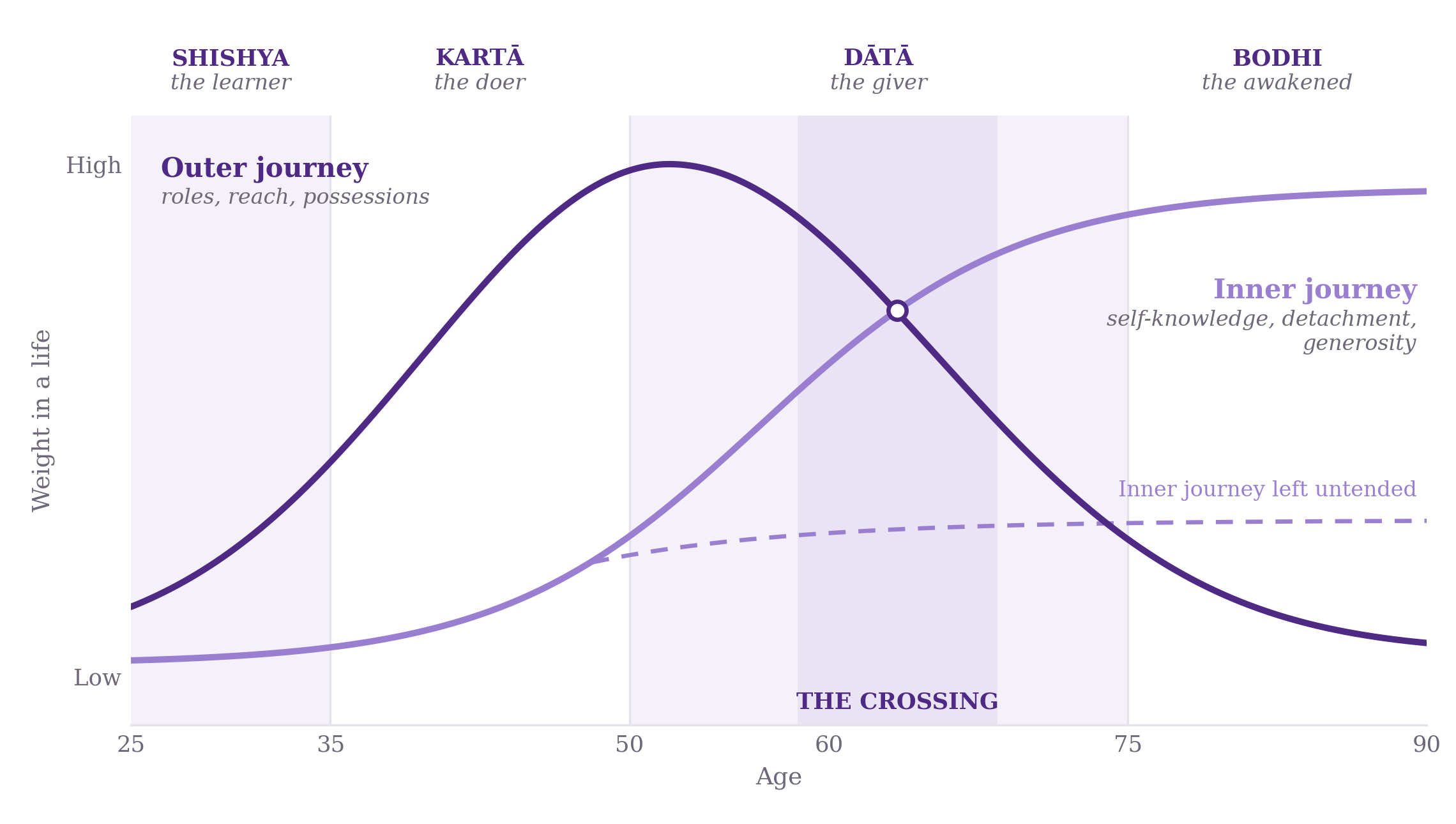
Illustrative. The outer journey is the growth of roles, reach, and possessions. The inner journey is the growth of self-knowledge, detachment, and generosity. Stage names follow my adaptation of the four ashramas.
When the Portfolio Becomes the Old Job
Consider what happens when a retiring executive builds the standard portfolio. The calendar fills again, now with board meetings, client calls, and course preparation. A part-time assistant replaces the staff. Fees and board seats replace salary and title as the measure of success. The social connections that once produced deals now produce engagements. The introduction still begins with the word former. Every element of the corporate career has been kept, at a smaller scale and spread across several organizations.
There is nothing wrong with any of these activities. I serve on boards, advise companies, and teach, and all three remain part of my life. The problem is that a portfolio of professional roles, however well designed, reconfigures the outer journey and leaves the inner journey where it was. The person who spent thirty years asking what can I achieve now asks how can I stay relevant.
Teaching shows the distinction most clearly. A former executive can stand in front of a class and present, which is a performance of past achievement. Or they can teach, which is an act of giving whose success is measured in someone else’s understanding. The room, the slides, and the hour are the same in both cases. But the posture is very different. The Bhagavad Gita offers a test for telling the two apart. The purest gift, Krishna says, is one given because it ought to be given, to someone who cannot repay it, at the right place and time (17.20). Most of the standard portfolio pays. That does not disqualify it, but it does mean that a life built entirely of paid roles has not yet been tested for generosity.
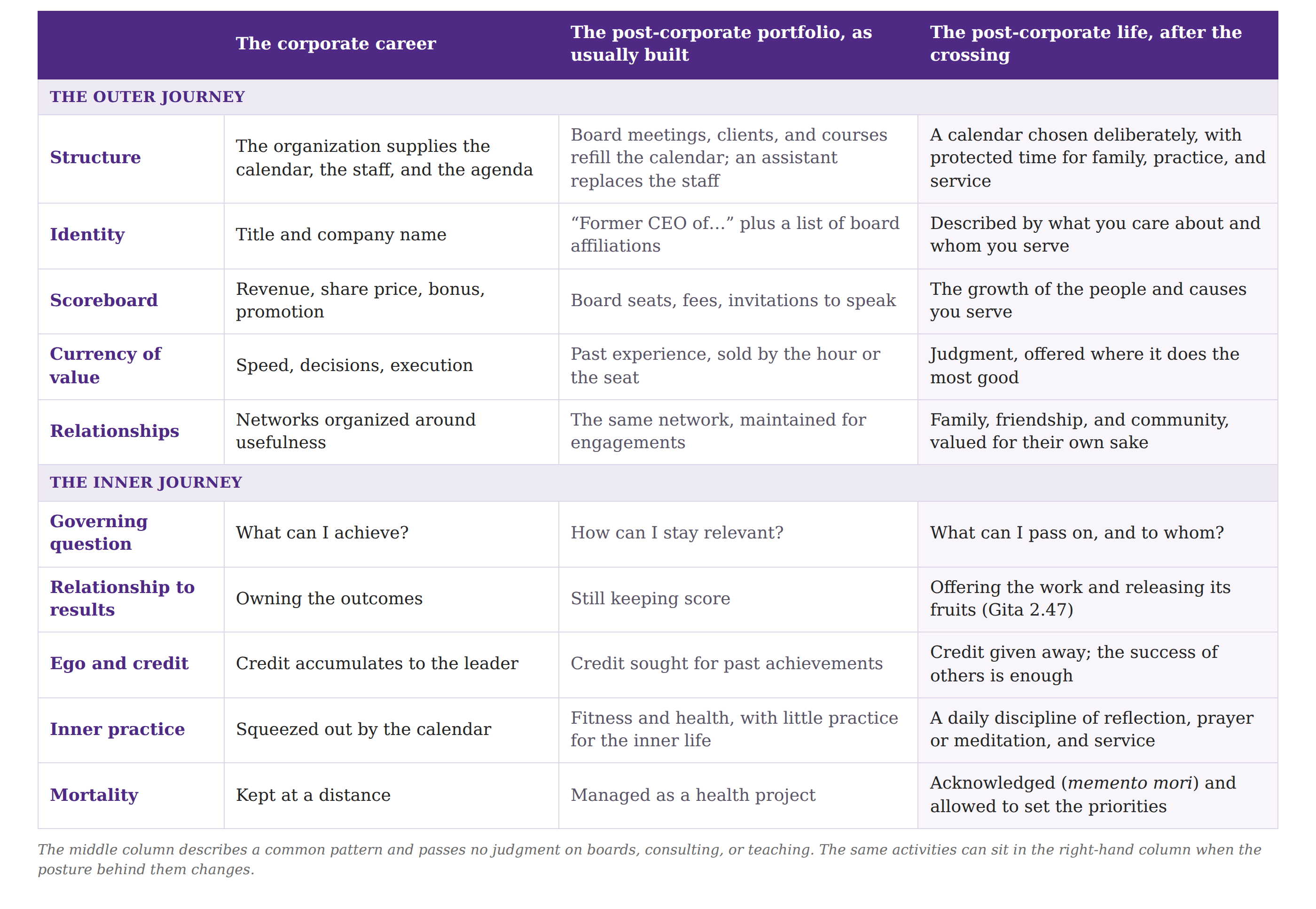
Exhibit 2 sets the corporate career beside two versions of what follows it: the portfolio as it is usually built, and the life that follows a completed crossing. The outer rows describe the shape of the days, and the inner rows describe the person living them. Read down the middle column and the pattern becomes clear. The corporate career has been preserved at a smaller scale.
Exhibit 2. The Corporate Career and Two Post-Corporate Careers
The Inner Journey
If boards, consulting, and teaching furnish the outer journey, what furnishes the inner one? The traditions I know best describe four movements, and each comes with a practice.
The first is the movement from role to self. The Guru Granth Sahib opens by naming the Divine Kartā Purakh, the Creator Being (Ang 1), and Japji Sahib calls the Divine the one Giver of all beings, sabhnā jīā kā ik dātā (Ang 2). Doer and giver, the two titles a career confers, belong in my tradition to God, and every person who holds them holds them on loan. Leaving a corporate role is the moment the loan is called. The Gita makes the same point in practical language: your right is to the work alone, never to its fruits (2.47). Executives who kept some distance between themselves and their results tend to find the loss of a title painful and survivable, while those who fused the two often experience it as a loss of self. The practice is honest self-inquiry, and a good place to begin is to write a description of who you are without mentioning any role you have held.
The second is the movement from accumulating to giving. The Taittiriya Upanishad records the instruction a teacher gives his students as they finish their studies: give with faith, give in plenty, give with modesty, give with awe, and give with understanding (1.11.3). It is worth noticing that the lesson on giving is delivered at graduation, decades before the giving years begin. Guru Nanak compressed the whole ethic into two lines:
ਘਾਲਿ ਖਾਇ ਕਿਛੁ ਹਥਹੁ ਦੇਇ ॥ ਨਾਨਕ ਰਾਹੁ ਪਛਾਣਹਿ ਸੇਇ ॥
Ghāl khāe kichh hathhu de-e. Nānak rāhu pachhāṇeh se-e.
One who earns by honest toil and gives some of it with his own hands, says Nanak, recognizes the path. (Ang 1245)
Earning by honest toil is the discipline of the doer. Giving with your own hands, which means your own time and attention along with your money, is the discipline of the giver. The practice is personal service performed regularly, what Sikhs call seva, and it counts most where nobody is watching.
The third is the movement from being needed to making others capable. For decades, relevance meant being needed: the decision waited for you, and the meeting could not start without you. After the crossing, relevance is measured by how capable the people around you have become. The test is simple and uncomfortable. When someone else takes credit for work you made possible, can you let it pass without correcting the record? The practice is mentoring without steering, which means advising successors when they ask and keeping your hands off the wheel when they do not.
The fourth is the movement from avoiding mortality to remembering it. The Romans called it memento mori (remember that you must die). Guru Nanak sang of it in the Alāhṇīāṅ, hymns composed in the form of the dirges that Punjabi women sang at a death:
ਸਾਹਿਬੁ ਸਮੑਾਲਿਹ ਪੰਥੁ ਨਿਹਾਲਿਹ ਅਸਾ ਭਿ ਓਥੈ ਜਾਣਾ ॥
Sāhib samhālih panth nihālih asā bhi othai jāṇā.
Remember the Master and keep watch on the road; we too must go there. (Ang 579)
Everyone at this threshold knows this, and most live as though the going were a long way off. Keeping watch on the road, as the verse asks, is a daily contemplative discipline - meditation, prayer, silence, or the slow study of wisdom literature. Many retired executives train diligently to protect their bodies. Very few have a comparable practice for the inner life, although it needs the same steady training and takes just as long to build. Anyone who has sat through a silent retreat, as I did for ten days at a Vipassana course, learns quickly that stillness does not arrive on command.
None of these movements requires leaving the world. My own faith is emphatic on the point. Guru Nanak spent the last two decades of his life, from around 1520 until 1539, farming at Kartarpur among his family and a community built around shared labor and a common kitchen. The inner journey he taught was lived at the center of ordinary life.
The Circle Around You
The crossing also reshapes the circle of people around you. Retirement renegotiates a marriage. A spouse who has built a life of their own over thirty years now shares the house at noon. Manu allowed the forest dweller to take his wife with him, and the crossing goes better when a couple designs it together.
The wider circle changes too. A career runs on networks, and networks are organized around usefulness. The years after the crossing run on friendship and community, which are valued for their own sake. Many of the friendships that sustain me began when I was a teenager at IIT Delhi, and our class of 1985 gathered for its fortieth reunion this February. Relationships of that kind deserve more of the time a retired executive once gave to the contact list.
What to Release and What to Carry
Retirement is one passage with two crossings, and each calls for a plan. Most executives have a detailed plan for the outer crossing. The inner crossing needs a plan made with the same seriousness. This plan comes down to two decisions: what to release, and what to carry.
What to release follows from the four movements described above: the title as the answer to the question of who you are; the scoreboard of fees, seats, and rankings; the need to be needed, along with the credit that came with it; and the habit of treating mortality as a problem for later. None of these releases requires giving up a board seat or a consulting engagement. Each requires giving up a posture, which is harder, and nobody can do it on your behalf.
What to carry is a shorter list. When the forest dweller left home, he gave up his belongings and the produce of his fields, and he took with him the sacred fire and the implements of his daily rites (Manu 6.3 and 6.4). This was the household fire kindled at his wedding and kept alight through every year of family life (Pāraskara Gṛhyasūtra 1.2.1). The house, the fields, and the wealth stayed behind. The fire went with him, because it was the center of his dharma, the thing his whole life as a householder had been organized around.
Every executive has a fire of this kind, although few would describe it that way. It is the part of a working life that never belonged to the job: the values you refused to trade away, the judgment that took decades to earn, the capacity to care for the people in your charge, and whatever faith or practice carried you through the hard years. That is what crosses over. The portfolio can be assembled and reassembled many times in the next thirty years, while the fire can only be carried, and it goes out if it is not tended.
A plan for the inner crossing can begin with four questions:
Who am I, described without reference to any title I have held?
What in my portfolio am I doing only for the scoreboard?
Whom am I helping to grow who cannot repay me?
What daily practice am I building for the inner journey, and when did I last do it?
The plan for my outer crossing will make my later years comfortable. The plan for my inner crossing will make them matter.
My father died at fifty-nine. The years after sixty are a gift he never received, and as I stand at this threshold I have been given that gift and must make the most of it. The plan for my outer crossing will make my later years comfortable. The plan for my inner crossing will make them matter. You will know the inner crossing is complete on the day you can introduce yourself without the word former, and the description that takes its place is true of the person you are becoming.
Sources
Verse and page numbers in parentheses in the text refer to the following editions. Where no translator is named, the rendering is mine.
Bhagavad Gītā 2.47 (karmaṇy evādhikāras te mā phaleṣu kadācana) and 17.20 (dātavyam iti yad dānaṃ dīyate ‘nupakāriṇe, deśe kāle ca pātre ca tad dānaṃ sāttvikaṃ smṛtam).
Manusmṛti 6.2, 6.3, 6.4, and 6.8. Quoted phrases follow Georg Bühler, trans., The Laws of Manu, Sacred Books of the East, vol. 25 (Oxford: Clarendon Press, 1886). For the critical edition, see Patrick Olivelle, ed. and trans., Manu’s Code of Law: A Critical Edition and Translation of the Mānava-Dharmaśāstra (New York: Oxford University Press, 2005).
McLeod, W. H. Gurū Nānak and the Sikh Religion. Oxford: Clarendon Press, 1968. Guru Nanak settled at Kartarpur, on the Ravi, after his travels; sources place the founding between about 1520 and 1522, and his death there on September 22, 1539. See also the entry “Kartarpur” in Harbans Singh, ed., The Encyclopaedia of Sikhism, 4 vols. (Patiala: Punjabi University, 1992 to 1998).
Olivelle, Patrick. The Āśrama System: The History and Hermeneutics of a Religious Institution. New York: Oxford University Press, 1993. The four āśramas first appear in the Dharmasūtras of Āpastamba, Gautama, Baudhāyana, and Vasiṣṭha, composed roughly between the third century BCE and the first century CE; see Olivelle, trans., Dharmasūtras: The Law Codes of Ancient India (Oxford: Oxford University Press, 1999).
Pāraskara Gṛhyasūtra 1.2.1: “The setting up of the domestic fire is performed at the time of his wedding.” In Hermann Oldenberg, trans., The Gṛihya-Sūtras: Rules of Vedic Domestic Ceremonies, part 1, Sacred Books of the East, vol. 29 (Oxford: Clarendon Press, 1886). Manu 6.4 itself mentions only the sacred fire and the implements of domestic sacrifice.
Srī Gurū Granth Sāhib. Ang 1 (Mūl Mantar); Ang 2 (Japjī Sāhib, paurīs 5 and 6, both closing with sabhnā jīā kā ik dātā so mai visar na jāī); Ang 579 (Rāg Vaḍhans Mahalā 1, from the Alāhṇīāṅ, which begin at Ang 578); Ang 1245 (Salok Mahalā 1, in Sārang kī Vār). Transliterations and translations are mine; all verified at gurugranthsahib.io.
Taittirīya Upaniṣad 1.11.3, Śikṣāvallī: śraddhayā deyam, aśraddhayā adeyam, śriyā deyam, hriyā deyam, bhiyā deyam, saṃvidā deyam. Compare Patrick Olivelle, trans., Upaniṣads (Oxford: Oxford University Press, 1996).
• • •