

A friend sent me a message a couple of days ago that said, ‘What do you think?’ Attached was a press release: Hg, the European private equity firm, was partnering with Anthropic to launch a European AI consulting firm that will place engineers inside the companies it owns, to build and run AI systems there. The message was innocuous and the press release seemed routine, till I dug deeper. As I read the press release, it triggered something that had been marinating in my head for a year. The announcement talked about three things that have been bothering me.
A frontier lab was moving into the work that consulting and technology services firms do.
A private equity fund was financing that work for its own portfolio rather than buying it from the firms.
The announcement made no mention of the people who would once have learned the trade by doing that work.
That message was the spark. This three-part series is the fire.
For more than three decades, I have prepared students for the entry-level work of consulting and technology services firms, and thousands of my students work in these firms, some in very senior positions. I advise the same firms, so I understand how they work. These firms are my clients and my students’ employers. Ironically, I also compete with them through a two-person AI startup called Pedagogix that I co-founded earlier this year. In all these roles, I keep returning to the same questions. If AI does the work that trained the experts, who trains the next generation of experts? And what happens to the firms, the schools, and the careers built on the old model of professional services firms?
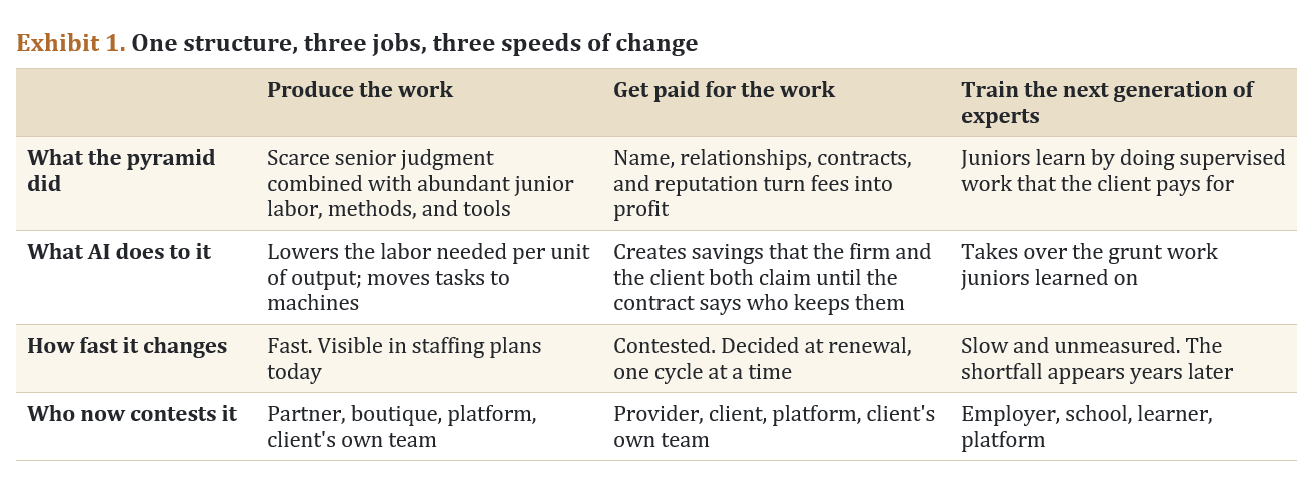
The professional services firm does three jobs with the same people. It produces expert work, it gets paid for that work, and it trains the next generation of experts. Clients pay for all three jobs with one invoice. AI hits the three jobs differently. The first job, producing the work, becomes cheaper, while the judgment that directs the work becomes more valuable. The second job, getting paid, becomes a contest: when the work costs less, the firm and the client both claim the savings, and contracts must define who keeps them. The third job, training, is hollowed out, because the grunt work juniors learned on is the first to be taken over by AI.
The pyramid could do all three jobs at once because one input did all three. Junior labor produced the work, the client paid for the junior hours, and those hours were how the juniors learned. Take out the junior labor and the bundle falls apart. That is the claim of this three-part essay series.
The pyramid will shrink as a production system, because firms no longer need a wide base of juniors to do the work. It has no replacement yet as a training system, because there is no alternative mechanism to turn a rookie consultant into a partner, and the replacement will have to be built on purpose, by the firms and the business schools together. So each of the three jobs now needs its own answer: who produces the work, who keeps the savings, and who builds the apprenticeship when the client’s fee no longer pays for it by accident. Firms, clients, and business schools still behave as if the old bundle is viable. It is not, and training of consultants is the first job to lose its payer.
The client pays one consulting fee. That fee covers the senior partner’s judgment, the analysts who build the models and draft the slides, and the education of those analysts, a few of whom will become the trusted advisers of the future. The client negotiates the first two and never sees the third. It is buried in the analysts’ hours.
The unbundling has already started, and the parties doing it are the ones that supply the firms with their intelligence. The Hg announcement that started this was the latest in a line. In 2026, Anthropic helped launch Ode, a company that places engineers inside enterprises to build and run AI systems, with Blackstone and Hellman & Friedman as its partners, and the Hg venture is its European counterpart. OpenAI launched its own Deployment Company, and its investors include McKinsey and Bain. The labs that sell models to the large consulting firms are now financing companies that deliver what those firms deliver, the private equity funds are financing the deployment capacity for their own portfolios, and the consulting firms have signed up with the labs anyway. That three-sided contest among the labs, the firms, and the funds runs through all three essays, because each side has a claim on the work, on the savings, and on the people who will be trained to do it. Part One takes up what it means for the firms. The job of producing expert work has found new suppliers. The other two jobs have not.
What the pyramid was for
The professional services pyramid is a familiar design: a few partners at the top, a wide base of analysts and associates below, and leverage in between. The drawing hides what the structure did, because the same people did all three jobs and the drawing shows one of them.
The first job was production. Partners combined their scarce judgment with abundant labor below, plus methods, data, and tools, to deliver something a client would pay for.
The second job was getting paid. The firm’s name, relationships, contracts, and reputation allowed it to charge fees well above the cost of the labor and to keep the difference.
The third job was training the next generation of experts. Each generation learned by doing the work of the generation below it, under supervision, on real problems, at the client’s expense. Analysts struggled through their first financial models and client decks, and the struggle is what taught them how the work is done.
The technology services firms ran the same three jobs on a larger base. Thousands of engineers integrated and operated enterprise systems, the firm billed their hours at a markup, and the engineers learned the trade by fixing what broke. Business schools and engineering colleges fed both kinds of firm, and the division of labor was never written down: the school taught the theory, and the firm supplied the practice on the client’s bill.
AI changes the three jobs at different speeds. Exhibit 1 lays out how.
Christensen was early, not wrong
In an October 2013 HBR article, Clayton Christensen, Dina Wang, and Derek van Bever argued that the big strategy firms would go the way of the industries they had advised: clients would stop buying the whole package and buy the pieces instead, from freelance networks such as Eden McCallum and Business Talent Group, from data and analytics vendors, and from their own in-house strategy teams. The article was widely read and discussed, but the prediction did not come true. McKinsey, Bain, and BCG are larger today than they were in 2013. The entrants of that era had a new business model and the same way of producing the work. They still needed people to do the analysis, and the incumbents had better people. In 2026 the labor that produces the work has itself become cheap. Richard Susskind made a related argument in 2015, that professional work decomposes into tasks and that machines will take many of them. Susskind asked what society owes the professions once machines can do their work. I ask a narrower question: what the client pays the firm for, and what the firm and the school owe the apprentice who used to learn on the client’s bill.
That question has three parts, one for each job the pyramid used to do. Who produces the work when the firm no longer needs a base of juniors to do it? Who keeps the savings when the work gets cheaper? And who builds the apprenticeship when the client’s fee no longer covers it? Three essays follow, one for each question: the work, the savings, and the training.
The three essays
Part One, The Partner Without the Firm: What AI Does to the Consulting Pyramid, asks whether elite partners still need the firm around them, and how much of a partner’s value belongs to the partner and how much to the firm. It maps the alliances of 2026 among the frontier labs, the consulting firms, and the private equity funds, and the contest among them for the forward-deployed engineer.
Part Two, Splitting the AI Dividend: Who Keeps the Savings When AI Cuts the Cost of Expert Work, follows a managed-services contract through an AI transformation and asks who captures the value at renewal: the provider, the client, the platform, the labs’ own deployment companies, or the client’s own team.
Part Three, Building the Apprenticeship: Who Will Pay to Make the Next Expert, asks who builds the apprenticeship when the client no longer pays for it by accident, and argues that the business school must build it, on the model medicine built a century ago: students embedded with employers from admission, rotations through practice, a match into residencies in place of a job search, and theory taught in the classroom after practice rather than before it. It is the essay closest to my own work.
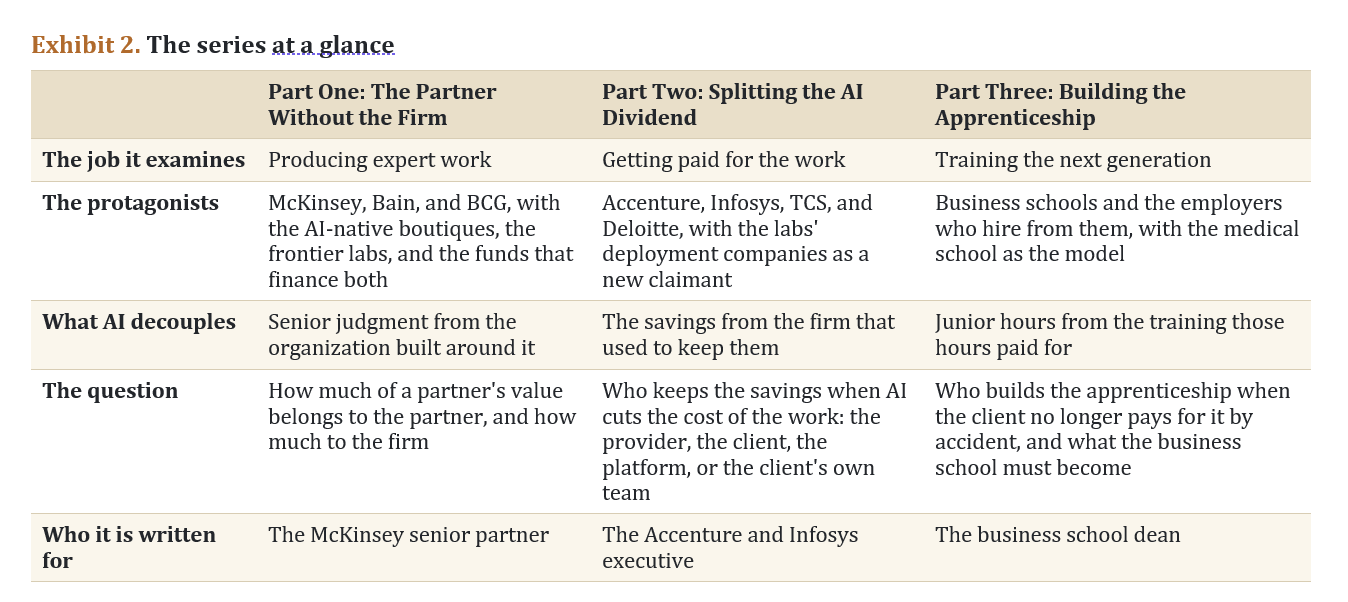
The three essays attempt to answer the question I started with. The pyramid is shrinking as a production system, and no firm, client, or platform will rebuild it as one. The savings it produces will go to whoever holds the bargaining power at renewal, and the contracts that decide that are being written now. The apprenticeship it supplied by accident will have to be built on purpose, with a budget, a ladder, and a supervising partner, and the business school can do the most of that work and must change the most to do it. AI is unmaking the system that made the experts. This series is about remaking it, and about who will do the work. Stay tuned for the series, which I will post one essay at a time.
In theory, this all sounds like you're asking the right questions. But the key assumption of Part 3 (and perhaps the others) is that AI remains at the level it is today. Changing our educational system is a long road - decades, at least. Instead, AI will gobble up the experts' roles too, far sooner than we might anticipate. And then gobble up the firms themselves. Then what? Will AI truly make progress beyond the existing market systems? What will the role of any human be?
It's not so much a question of what to do, but where is the puck truly heading, how fast, and can anyone skate fast enough to get in front of it.