


In two weeks, I will teach the final lecture of my product management MBA course at Kellogg. On a whim, I pivoted on what I had originally planned to teach. We have spent 18 sessions learning frameworks for building great products and making them commercially successful. Rather than spend the last session on more frameworks, I thought I would deal with the elephant we kept out of the classroom - how to know what is enduring at a time when everything feels so ephemeral? How can we build products that will not become Claude features in three months? How can we build careers that the 80-year old version of ourselves would be proud of? What does not change at time when change is relentless? Are we doomed to building castles in the sand, which will be swept away by the waves of disruption? Does anything endure?
I ended up with a lecture that I had never planned on giving. And the students certainly ended up with a lecture they had never expected to hear. I am writing down the ideas here because the lesson belongs to a wider audience. I am writing it as a letter because that is how I approached the topic - as a meditation, not as PowerPoint slides.
The heat, the dust and the fog
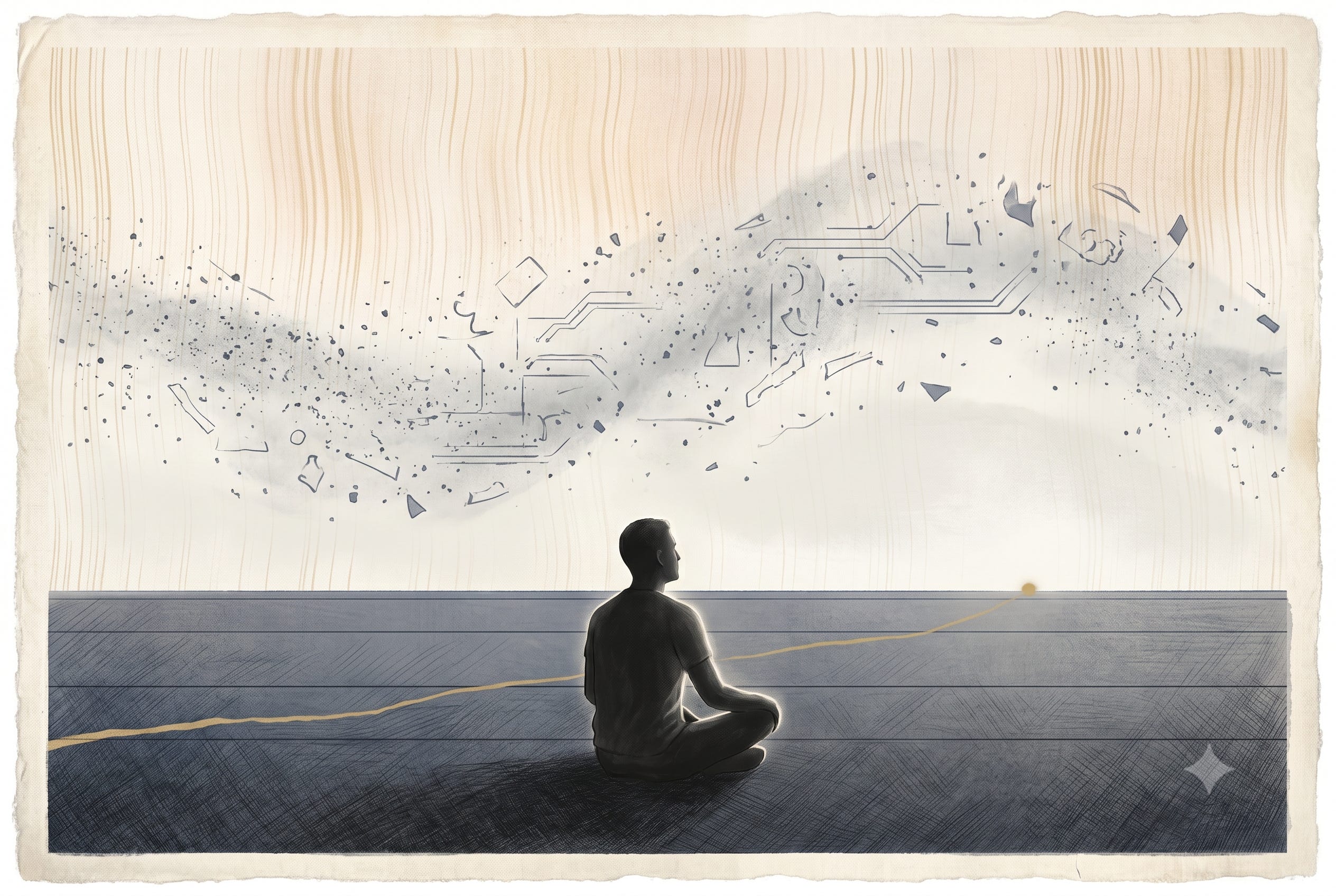
In 1975, Ruth Prawer Jhabvala wrote a novel called “Heat and Dust”, set in colonial India. The title comes from the atmosphere of oppressive weather and dusty surroundings. This is an apt metaphor for the unsettling times we live in. The heat is the urgency of the moment, the felt pressure that every email is important and every Slack ping is real. The dust is the swirl of activity that obscures vision, the cloud of frameworks and tools and titles and announcements that move past you faster than you can absorb them. There is also, behind both, a fog. The fog is the uncertainty about what comes next.
Together they form the medium that my students will live in as product managers. They also form the medium within which our internal world will unfold.
Look at what lands in a 2026 PM’s inbox before lunch. A frontier model release with new benchmark claims. A pricing experiment from a competitor. A new agent frameworks to evaluate. A LinkedIn thread you must read. A title change at a peer company. An urgent rewrite of last quarter’s strategy. Almost none of it will matter in five years. The model shaking the industry today will be the baseline assumption next year. The framework you are anxious to learn will be replaced by a better one. The title you coveted will possibly cease to exist in five years.
The proposition I left my students with is this. Twenty-year clarity is not gained by better forecasting. Clarity comes from the ability to discern what endures by listening to the silence among the screams. The product manager who internalizes this distinction wins twice. Once in the products she builds. And once, more quietly and more lastingly, in the person she becomes.
A trip down memory lane - what died, what lives
Cast yourself back to 1996. I was a young Kellogg professor then. Most of my MBA students had not yet been born. That year the most exciting product on earth was AOL, with thirty million subscribers and rising. Netscape had just gone public in the most consequential technology IPO of the decade. Yahoo Directory was how you found things online. AltaVista was the search engine for serious users. Lotus 1-2-3 was the spreadsheet that ran every enterprise I taught. Real Networks owned streaming media. Compuserve was the professional online service. Every name on that list felt like the future. Every one is now gone, or has been reduced to a curiosity.
Now look at what was quietly working underneath, in the boring infrastructure nobody wrote magazine covers about. SQL, invented in 1974, was already how data was queried. It is still how data is queried in every billion-dollar SaaS company today. TCP/IP routed packets between machines in 1996. Still does. Email, the relational database, the hyperlink. All of them quiet. All of them durable.
Push the experiment further back. Double-entry bookkeeping was codified by Luca Pacioli in 1494 and is still how every company on earth keeps its books. Navigation by the stars is more than five thousand years old and is still taught at the United States Naval Academy as a backup to satellite navigation, because the job, knowing where you are on a moving planet, has not changed.
Durable products solve underlying jobs that do not change. Ephemeral products solve surface expressions of those jobs that the next technology cycle will replace.
The pattern is the lesson. Durable products solve underlying jobs that do not change. Ephemeral products solve surface expressions of those jobs, expressions that the next technology cycle will replace. The most useful question you can ask of any product you are about to build, evaluate, or join is whether it is an underlying job or a surface expression. If the honest answer is surface, the next platform will eat it. If the honest answer is underlying, the next platform will run on top of it.
Five moats that survive
In my lecture I walked my students through five categories of advantage that have survived every major platform shift of the last fifty years. Each is grounded in something a frontier model cannot have.
The first is proprietary workflow data. Bloomberg, founded 1981, generates over eleven billion dollars a year because every quote, every trade, every chat between traders happens inside the terminal. The data is a byproduct of the work. A model can read every public filing in seconds. It cannot read the order book that lives only inside the terminal.
The second is regulated trust. Moody’s was founded in 1909 and designated a Nationally Recognized Statistical Rating Organization in 1975. A model could probably rate bonds more accurately than Moody’s tomorrow. That rating would not satisfy the regulator. Trust of this kind is a permission slip granted by an institutional process that takes decades.
The third is distribution depth. Visa has nearly five billion cards on earth, accepted at one hundred and fifty million merchants. It has survived imprinter, magstripe, chip, NFC, mobile, and the rise of cryptocurrency. Apple Pay sits on top of Visa, not in place of it. Distribution is physical and institutional. It is built by decades of contracts that AI cannot accelerate.
The fourth is integration depth. SAP runs more than three quarters of global business transactions. A typical SAP implementation takes three to seven years and tens of millions of dollars to remove. A model could write better business logic than SAP. It will become a feature inside SAP, never a replacement of it.
The fifth is taste, compounded across decades. Apple has shipped breakthrough products across five distinct platform eras. Hermès has been making leather goods since 1837. Patagonia has been making outdoor gear since 1973. Taste is the rarest moat to build and the easiest to misjudge. A company that has shown taste within one tooling cycle has not yet shown it through one. Apple has shown it through five. That is the difference.
The same five moats, turned inward
Here is where my lecture pivoted. And here is where I want to slow down with you now.
The five moats for products are the same five moats for a life. The parallel runs on mechanism, with the same compounding logic. Each personal moat is built the way each product moat is built, by repeated small deposits over long periods of time, and none can be acquired by paying for them.
Accumulated taste from years of practice becomes your proprietary data. Professional reputation, the kind built by three decades in the same industry, becomes your regulated trust. The depth of your network, weighted by reach and diversity and quality, becomes your distribution. Domain mastery, the ten thousand hours honestly counted, becomes your integration depth. Character and judgment, expressed in the small decisions nobody is watching, become your taste.
Warren Buffett, born in 1930, has read roughly five hundred pages a day for more than seventy years. Charlie Munger said in a 1994 speech at USC that in his whole life he had known no wise people who did not read all the time. None, zero. Buffett and Munger compounded Berkshire’s book value at roughly twenty percent annually for fifty-eight years. The returns are the public record. The reading is the private one. They built taste in silence, mostly alone, for many decades before the world noticed.
Tim Cook joined Apple in March 1998 at the age of thirty-seven, when Apple was nearly bankrupt. He is sixty-four now. He has been at Apple for the entire arc of his fifties and most of his sixties. He has compounded a kind of trust that no lateral hire can manufacture, denominated in years of consistent behavior, paid out in moments of consequence.
The Harvard Study of Adult Development is the longest study of human life ever conducted. After eighty-five years and more than thirteen hundred participants, the clearest finding is a single sentence. The biggest predictor of long-term happiness and physical health is not wealth, fame, achievement, intelligence, or even genetics. It is the quality of close relationships. Robert Waldinger, who directs the study now, has said that loneliness is comparable in its health effects to smoking or alcoholism. The moat that matters most, on the evidence, is the third one. The network. Built by unprompted notes, over decades, with no agenda.
What the wisdom traditions say, together
I am Sikh, and the verse I have come back to most often in my own life is in the opening stanza of the Sri Guru Granth Sahib, our holy scripture. The Mool Mantar, as it is called, is the first composition of Guru Nanak Dev, recited each morning by Sikhs across the world. One phrase from it has been a quiet drumbeat in my mind for more than fifty years.
Aad sach. Jugaad sach. Hai bhee sach. Naanak hosee bhee sach.
True at the start. True through the ages. True even now. Nanak says, will be true forevermore.
The verse is a definition of the eternal, written in the early sixteenth century. It is also, if you let it be, the cleanest test for whether anything you are building is worth your life. Read it slowly, because what is happening in those four lines is more than poetry. It is a four-question filter for an entire existence.
What is remarkable, when you start to look, is how often the same instruction shows up in other traditions, in completely different idioms. Marcus Aurelius, writing in his journal in the second century, called the noise of the moment a river of passing events, and noted how strong the current is, and how no sooner is a thing brought to sight than it is swept by. The Zen tradition has a saying: “before enlightenment, chop wood, carry water; after enlightenment, chop wood, carry water”. The Bhagavad Gita gives us karma yoga, the practice of doing the work without attachment to the fruit of the work.
Four traditions over three millennia give you one lesson. See past the river of passing events to the thing that does not pass. Do the underlying work, faithfully, regardless of what the moment is shouting at you.
A test, in four questions
From the convergence, a practical test emerges. Four questions to run before any consequential decision, in your product, your career, or your life. The questions are the Mool Mantar translated into the language of work.
Was it true at the start. Is this a fundamental human job, or a temporary expression of one? Communication is a fundamental job. Email is a temporary expression. Curiosity is fundamental. Twitter is a temporary expression. Love is fundamental. The dating apps that mediate it are temporary expressions. Build the fundamentals. Use the expressions.
Has it been true through the ages. Has the underlying need shown up in every era of recorded history? Trust between strangers has. Yelp ratings have not. The job will outlast the tooling. Bet on the job.
Is it true now. Strip away the hype. Is the underlying job actually being solved by what you are building, or is the hype carrying the value? This is the most uncomfortable question of the four. It is also the question that keeps you honest.
Will it still be true. Will this still matter in twenty years to the people who do this work? If no, you are working on the dust. The dust can pay you well in the short term. It will not compound.
What you owe to the 80-year-old who will be you
Annie Dillard wrote a sentence in 1989 that has inspired me for a long time. How we spend our days is, of course, how we spend our lives. The phrase of course is doing a lot of work in that sentence. The hours you spend on Tuesday are the hours you spend on Wednesday, and the weeks become the years, and the years become the life. There is no separate life waiting once the dust settles, once the urgent work is finished, once you have made enough money to stop. There is only the life you are spending today.
Bronnie Ware was a palliative care nurse in Australia who spent eight years sitting with people in their last weeks. Her record of their most common regrets has been read by more than eight million people. None of the top regrets are about products that did not ship, deals that did not close, promotions that did not arrive. They are about the substrate underneath the career. I wish I had had the courage to live a life true to myself, not the life others expected of me. I wish I had not worked so hard. I wish I had stayed in touch with my friends. I wish I had let myself be happier. Ware noted that the second regret was particularly common among men. They had missed their children’s youth and their partners’ companionship for a career that, from the perspective of a deathbed, no longer seemed to have justified the trade.
Read that list slowly. Read it as a letter, written from the person you will be at eighty to the person you are this Tuesday. She has read the rest of the book. You have not.
The most useful advisor you will ever have is that eighty-year-old version of yourself. Before any consequential choice, run the decision past her. Will I still be proud of how I made this decision? Did I build something my eighty-year-old self would respect? Did I spend my limited cognitive energy on what eventually mattered, rather than on what shouted loudest?
The line I left them with
Three heuristics to carry out of this letter.
First, build for the customer your grandmother would understand. If you cannot explain the underlying job to a non-technical adult who has lived eighty years, you are probably working on a surface expression of one.
Second, optimize for the version of yourself you will meet at eighty. The accolades the thirty-year-old chases tend to mean little at sixty. The things the eighty-year-old respects tend to start at thirty.
Third, the product you are most responsible for is the one reading this letter. Every framework I have ever taught about products applies to you. Grow your five moats with deliberate deposits. Evolve the parts of your life that no longer earn their place. Be the gardener of yourself, not the architect.
The heat and the dust and the fog are ephemeral. What endures is the stillness beneath and the clarity beyond.
The heat and the dust and the fog are ephemeral. What endures is the stillness beneath and the clarity beyond.
Frontier models will eventually do everything they can do. Your job is to be where they cannot reach. So is your career. So is the life that runs underneath both.
Build the things you would still be proud of when you are eighty. Including yourself.
* * *
This was the capstone lecture of MKTG 458 at Kellogg this spring. The companion course reading runs to six thousand words and goes deeper on each of the five moats. Reach out if you would like a copy.
Enduring lessons here! My fav was listen to the silence among the screams 👏
This is a master class on what is durable - and thus how to think about a lasting business impact in the face of 30-day product cycles!!
Must-read for anyone, but especially founders of companies coming of age right now.
As the founder and CEO of a software start-up, I found this to be an optimistic view of the future.
Thanks for sharing and congrats on your amazing career teaching.